
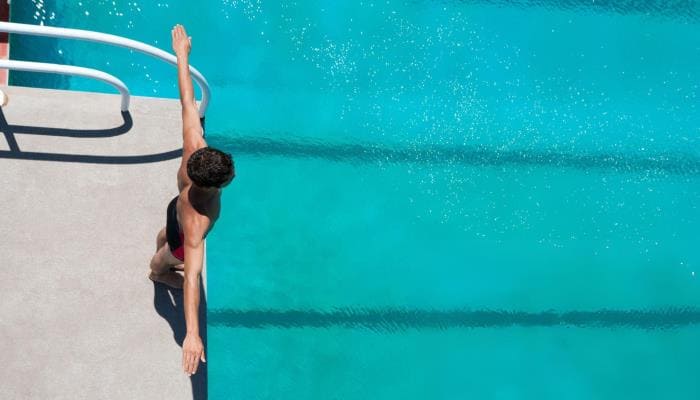
Diving is a spectacular combination of art, acrobatics, and physics. The price of a mistake here is comparable to hitting the asphalt.
#Diving #SummerSports #OlympicSports
Diving is not just a sport, it is the art of overcoming fear, physics, and gravity, where the body becomes a tool for creating a perfect, yet fleeting sculpture in the air. The essence of diving lies in the paradoxical combination of weightless flight and mathematical precision, where a mistake of a centimeter or a degree can turn soft water into hard asphalt.
The essence of sport: the line between beauty and risk
The basis is a controlled fall, transformed into a short but complex performance. In a matter of seconds, the athlete must:
- Perform a powerful and aesthetic push-off.
- In flight, perform a series of rotations and twists with perfect grouping.
- Enter the water at an angle close to 90°, with minimal splashing.
The safety paradox lies in the entry technique: with the correct dive (head or feet first with limbs extended), the water offers minimal resistance. However, a flat impact (with the stomach or back) makes the water surface practically solid due to the sharp increase in contact area, which can lead to serious injuries. Thus, “water becomes asphalt” when the technique is violated due to the laws of hydrodynamics.
Interesting fact! When jumping from a 10-meter tower (roughly the height of a three-story building), athletes reach speeds of up to 55 km/h before entering the water. From a 3-meter springboard, they reach speeds of around 35 km/h.
The historical path: from necessity to Olympic discipline
The origins of the discipline lie in harsh necessity: Roman legionnaires and sailors of the sailing era mastered diving for survival. However, the sport was born in the 16th century in Switzerland, where people sought not only benefit but also beauty in the water. By the end of the 19th century, “whimsical diving” had taken shape as a competitive format, and since 1904, diving has been a permanent fixture in the Olympic program, evolving from simple “long jumps” to virtuoso ballet with spins and twists.
The development of the sport was enriched by spectacular pair and synchronized diving (which debuted at the 2000 Olympics), where the complexity of the elements is compounded by the requirement of absolute mirroring with one’s partner.
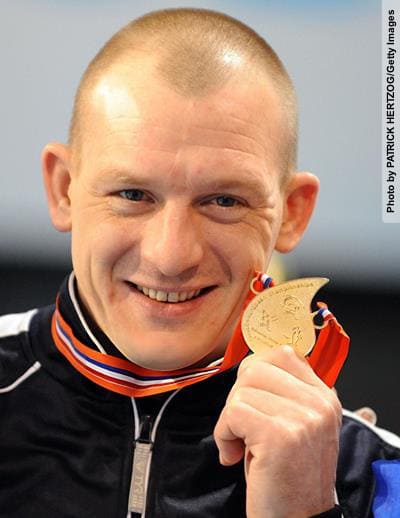
Dmitry Sautin is a unique phenomenon in the world of diving, a living legend and a symbol of sporting longevity. Awarded the title of best diver of the 20th century, the Russian has collected an unprecedented collection of awards: 8 Olympic medals, 5 victories at world championships and 11 at European championships.
Technical core: complexity, rules, and evaluation
- Apparatus: Springboard (3 m) and tower (5, 7.5, 10 m). At major competitions (Olympic Games, World Championships), a 3-meter springboard and a 10-meter tower are used.
- Arsenal: There are more than 150 combinations of elements (turns, twists) from various positions (front, back, hands). Each jump is assigned a difficulty coefficient (from 1.2 to 4.8).
- Scoring: The performance is evaluated by 7 judges (in synchronized diving, there are 9 + 5 judges for synchronisation). The judges assign a score from 0 to 10 points to each dive. To obtain the final score, the extreme scores (the lowest and highest) are discarded, the scores of the remaining judges are added together and multiplied by the difficulty coefficient of the element (from 1.2 to 4.8). The result of this calculation is then multiplied by 0.6.
- Program: At the Olympics, men perform 6 jumps (in the preliminary stage and in the final), women perform 5 (in all three stages).
Interesting fact! Diving pools must be at least 4.5 meters deep, and for 10-meter towers, they are often made even deeper (up to 6 meters) to ensure safe diving at high speeds.
The philosophy of the perfect jump
The main challenge for the athlete is to pack a flawless sequence of elements into 1.5-2 seconds of flight, each of which is critically important:
- Starting position and run-up: Must radiate calm composure and naturalness.
- Push-off: The moment of energy generation. Powerful and directed strictly upward, it determines the height and control of the flight.
- Flight phase (the jump itself): Here, the body, rotating at a speed of up to 4.5 revolutions, must maintain absolute geometry of lines. This is the peak of aesthetics and technical complexity.
- Entry into the water (“calibration”): The finale, which can devalue all the previous work. The ideal is a vertical entry at 90° with minimal splash, demonstrating complete control over the body.
The path to mastery: from the side rail to the tower
4–6 years old is the ideal age to get acquainted with water and start exercising. At this age, children usually begin with general fitness classes in the pool, water games, and learning basic skills: how to enter the water correctly, simple jumps from the side or a low diving board (0.5–1 meter). The emphasis is on strengthening muscles, developing coordination, and overcoming fear of heights.
7–10 years old is the optimal age to start full-fledged training. The child already has sufficient concentration and physical fitness and is able to master the technique of more complex jumps. At this age, many sports schools open enrollment in beginner training groups.
10-13 years old — practicing complex elements, mastering jumps from a height of 10 meters, participating in serious tournaments.
For adults, there are amateur groups where training is adapted to the level of preparation. The main thing is desire and the absence of medical restrictions. Many swimming pools offer master classes and courses for beginners, where they teach how to jump safely from springboards and platforms.
High diving: the art of flying and overcoming
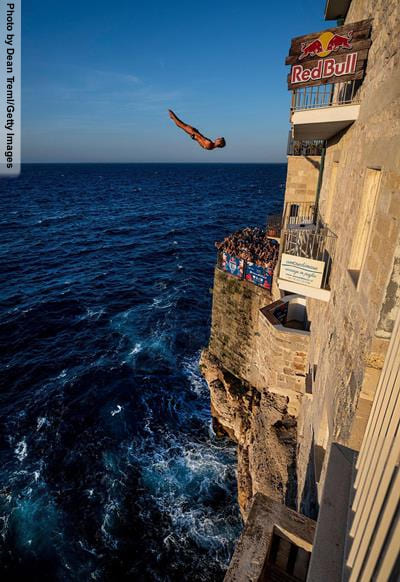
High diving is not just a discipline, but the pinnacle of extreme sports, where athletes compete not only with each other, but also with physics, fear, and the abyss.
Unlike jumping from a 10-meter tower, here athletes take off from platforms ranging from 27 meters (men) to 20 meters (women) to reach the water at speeds exceeding 85 km/h.
Competitions are held in open water (from sea platforms or special structures) or above deep pools. Athletes have only three seconds of free fall to perform acrobatic elements — somersaults, twists, and turns.
The difficulty lies not only in the technique, but also in the entry into the water: the slightest mistake in body position can result in serious injury due to the tremendous pressure on the muscles and joints.
Is diving the most beautiful sport?
Conclusion
Diving is the drama of overcoming. The brief moment between the push-off and the dive is a story of complete control over one’s body in conditions of extreme risk. Here, the aesthetics of ballet are subject to the laws of physics, and each medal is a reward for the ability to turn a fall into flight and water into a perfect but demanding stage.