
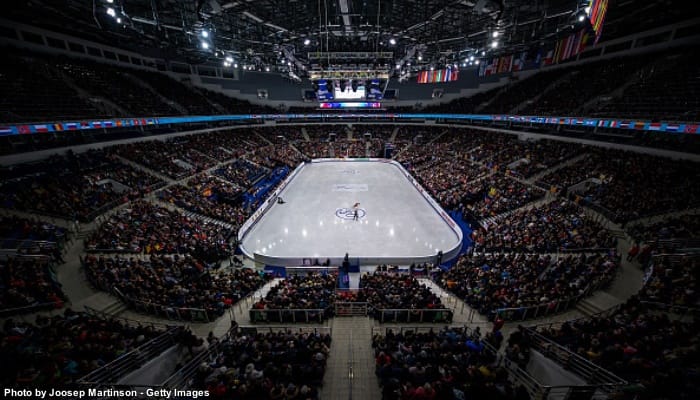
Sold-out crowds at Minsk Arena are more than just statistics. Find out why going to a hockey game has become as much a part of daily life in Minsk as an evening stroll through the city.
A major hockey club has its record, standings, roster, and coaching staff—and usually, nothing else matters beyond that. But Minsk’s “Dynamo” has something else that goes beyond the statistics. A home game at Minsk Arena has long been seen not just as a sporting event, but as part of the city’s evening routine: the drive down Pobediteley Avenue, meeting up at the entrance, waiting in line in the lobby, the roar of the stands, and the familiar anticipation of the first period.
A large arena changes the scale of expectations
“Minsk-Arena” immediately set the bar high for the club. When a team plays in a 15,000-seat arena, empty sections are just as noticeable as defensive mistakes. On the other hand, a packed arena turns an ordinary regular-season game into an event with an almost playoff-like atmosphere.
This is especially important for hockey. In a small arena, the atmosphere happens naturally: the fans are close by, the noise builds more intensely, and the excitement reaches the ice faster. A large arena requires a different culture of attendance. Fans need to come not just to see a top rival, but to support the team itself, to experience a familiar ritual, and to feel a sense of belonging.
For Minsk’s “Dynamo,” this combination has become one of its main pillars. The team may go through different phases of play, change leaders, or seek balance in its lineup, but a home game remains a recognizable part of the city’s identity. Here, hockey sells itself not only through the score but also through the atmosphere.
Why a full house doesn’t just happen on its own
A full house rarely results from just one successful winning streak. First, the club must be spectator-friendly: an easy-to-follow schedule, smooth logistics, recognizable branding, a family-friendly atmosphere, and a sense of safety and celebration. Only then does the sporting aspect come into play, where competition, character, and belief in the team are key.
In the case of Minsk’s Dynamo, it’s precisely this combination that works. Minsk Arena is located in a recognizable part of the city, and going to a hockey game doesn’t require a complicated explanation. It’s not an exclusive subculture for tactical experts, but an accessible evening out for a family, a group of friends, or anyone who simply wants to watch live sports.
There’s another factor as well. Hockey in Minsk fits well into the city’s calendar. A home game becomes a way to pass the time on a long evening, especially during the colder months. People come not only to watch shots and physical plays, but also to get a change of scenery, hear the collective roar, and feel the rhythm of the large arena.
The team as a source of shared emotion

What makes Minsk’s “Dynamo” interesting is that its fans often look beyond simply hoping for a title. For some fans, what matters is the club’s very struggle in a competitive league, where it must prove itself every season. This dynamic fosters a unique kind of support: the crowd appreciates not only a win, but also a pass, a blocked shot, a goalie save, or a physical play along the boards.
This makes the connection with the team more enduring. When a spectator understands hockey beyond just the score, they find it easier to accept difficult stretches of play. They see how the team breaks out of pressure, how the pace of the lines changes, and how the coach experiments with line combinations. In such an environment, the arena becomes a place to observe the process, not just a venue for celebrating the result.
For the club, this is a valuable resource. Players sense when the support doesn’t fade after the first mistake. Home-ice advantage doesn’t work through magic, but through psychology: it’s noisy for the opponent, familiar for the home team, and every successful play gets an immediate response.
An urban ritual is more powerful than a one-time event
Sustained interest in a club emerges when a game ceases to be a rare event. Spectators develop a routine: where to meet, when to arrive, which section is most convenient, where to buy team merchandise, and how to take a child to their first game. These details may seem mundane, but they are precisely what transforms the sports calendar into a part of city life.
Such a ritual is especially important for hockey, where the season is long and emotionally volatile. You can’t promise a spectacle on par with a championship game every night. But you can create the feeling that even an ordinary game carries significance, because it continues the shared history of the club and the stands.
In this sense, Minsk’s “Dynamo” has become more than just a team with a large arena. It has become a gathering place for different groups of spectators. Some come for the hockey, others for the atmosphere, and still others for a family evening, but in the end, everyone finds themselves caught up in the same excitement.
What sold-out games say about the club’s future
Sold-out crowds don’t guarantee athletic success, but they give the club room to grow. A full arena raises the bar for organization, communication, and the quality of the roster. Fans who are used to big hockey nights expect not just a fleeting burst of excitement, but sustained progress: stronger play, clear roster decisions, and a consistent coaching approach.
For “Dynamo,” this is both support and pressure. A large audience prevents the club from remaining an unremarkable mid-table team. Every season becomes a public conversation about where the team is headed and why it deserves such a large fan base.
That is precisely why Minsk Arena is important not just as a building. It sets the bar for the club. When fifteen thousand seats become the norm, hockey in Minsk ceases to be just another game on the schedule. It becomes a city tradition that must be reaffirmed every time through performance, attitude, and hard work on the ice.