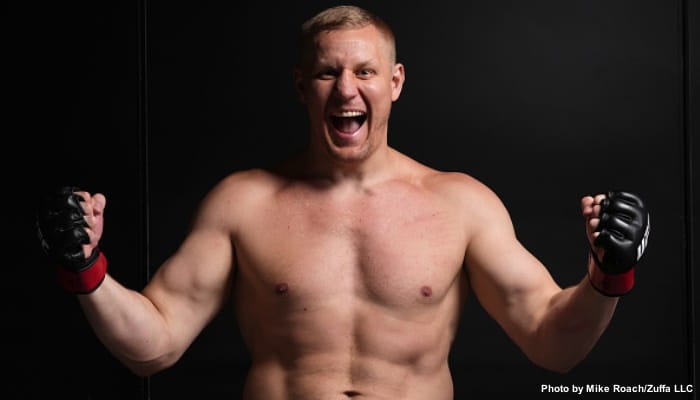
Sergey Pavlovich is more than just a “punching” heavyweight. In this article, we’ll break down how his long reach works, the psychology of applying pressure, and the hidden risks of being the top contender.
Sergey Pavlovich is one of those heavyweights who can’t be summed up with a single phrase about his powerful punch. Yes, his image is built around strength, reach, and quick finishes, but in mixed martial arts, such a reputation isn’t built on fists alone. What matters more is how a fighter chooses the moment when the distance has already been closed, and the opponent hasn’t had time to respond.
Pavlovich’s fights are usually watched with anticipation of the first brutal exchange, where a single misstep can decide everything. Pavlovich’s actual bouts unfold more simply and brutally: a heavyweight rarely forgives a delayed reaction, a wrong angle, or an attempt to wait out a dangerous moment.
Pavlovich’s strike begins before the swing
With a powerful heavyweight, a strike is often viewed as a standalone event: he lands it, forces his opponent off balance, and launches an attack. With Pavlovich, this sequence usually begins earlier. He doesn’t just throw a right or left straight; he forces his opponent to make a decision under pressure.
The main danger is that an exchange with him quickly becomes lopsided. The opponent may see the start of the attack but doesn’t always have time to step out of the line of fire. For a heavyweight, this is critical: the impact of the punch is massive, and the cost of a mistake is higher than in lighter weight classes.
That’s why Pavlovich’s power doesn’t work on its own. It requires preparation: footwork, body position, pressure with the lead hand, and the readiness to immediately follow up with an attack. When all these elements come together, the punch looks simple, even though it’s backed by precise mechanics.
Distance as a way to control an opponent’s fear
In the heavyweight division, distance is almost always a psychological factor. A fighter who fears getting hit raises his hands earlier, struggles to counter with his feet, and tends to retreat in a straight line. Pavlovich knows how to exploit this: he doesn’t necessarily rush forward, but his presence alone closes the gap.
His long reach allows him to launch attacks from a distance where his opponent still expects to be safe. This alters the familiar feel of the fight. The opponent is forced to either retreat or risk moving in, where every exchange could be the last.
This style doesn’t require constant circling. For Pavlovich, it’s more important to keep his opponent in front of him and not let him calmly reset the exchange. The fewer clear openings the opponent has, the higher the likelihood of a power clash on the Russian’s terms.
Fighting as the aggressor and its hidden cost

Pavlovich is often most dangerous precisely when he takes the initiative. He presses forward, meets his opponent’s attacks, lands flurries, and forces his opponent to defend not by design, but out of necessity. To the viewer, this looks like natural superiority, but this approach comes at a cost.
A fighter who takes the initiative doesn’t just expend energy. He leaves himself open to counterpunches, low kicks, and clinches against the cage. If the attack doesn’t finish quickly, he has to reset his stance and prevent his opponent from stealing the momentum.
For Pavlovich, this balance is particularly crucial. His style is effective when the pressure remains controlled. If the attack turns into a chase for a single big hit, the opponent gets a chance to slow the pace, force a grueling exchange, and shift the fight to a less favorable zone.
Why the clinch and the cage change the dynamic
For a heavyweight striker, the cage can be both an ally and a trap. On the one hand, it cuts off the opponent’s retreat. On the other, the cage makes it easier to force a clinch, tie up the opponent’s hands, slow down the fight, and eliminate the space needed for a sweeping flurry.
For Pavlovich, it’s important not just to press his opponent, but to maintain the ability to strike. If the distance becomes too short, some of his advantages disappear. His long arms no longer provide the same freedom, and every clinch turns the exchange into a battle for body position.
That’s why his best moments often occur between the center and the cage. There, the opponent has little room left, but Pavlovich still has space to strike. It is precisely this intermediate zone that makes his style so dangerous: the pressure is already being felt, but a way out has not yet been found.
Heavyweights don’t like excessive confidence
Pavlovich has a quality that’s essential for any spectacular knockout artist: he keeps the audience on the edge of their seats, waiting for the outcome. But the heavyweight division is a tricky business. The more eagerly the crowd awaits the finish, the more attention the fighter himself must pay to the tedious details: stance after an attack, defense while retreating, breathing, footwork.
A single power-based style cannot be the eternal answer to all opponents. Against a striker, one kind of caution is needed; against a grappler, another; against a durable heavyweight, a third. Pavlovich is interesting not only for how he breaks the distance, but also for how he’s learning not to rush where explosive power used to be enough.
This is where his place in the heavyweight division lies. He remains a fighter from whom a powerful strike is expected, but the real test for him is broader. It’s not just about landing the first blow, but ensuring that the first exchange doesn’t turn into a gamble. When power is combined with patience, the heavyweight ceases to be merely a knockout artist and becomes a fighter who controls fear, space, and the moment.