
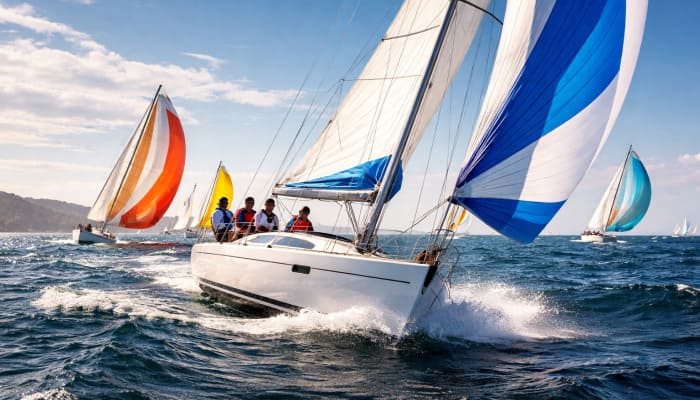
Sailing is a philosophy, a dialogue with the elements, and the highest form of tactical thinking. How to get started, what to wear, and why sailing changes your personality.
#Sailing #Sail #Yachting #SummerSports
Sailing is not just racing on water, but a dialogue with the elements, where tactical thinking, a feel for the wind, and intuition become the athlete’s main allies. Instead of the usual physical aggression, subtle calculation, patience, and the aesthetics of movement reign supreme here, turning every regatta into a high art form.
Essence and philosophy
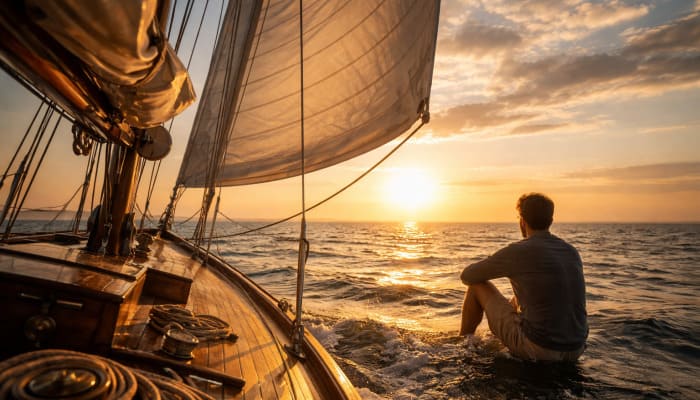
The main task in sailing races is to cover the distance faster than your rivals, using only the power of the wind. This makes each race a unique equation, where the variables are the weather, tactics, and the skill of the crew. Athletes do not move directly toward the goal: they are forced to tack, calculating the optimal course relative to the wind. This makes the race a battle of tacticians and strategists, where route selection and the ability to “read” the water and sky are often more important than pure physical strength.
The philosophy of sailing is freedom, accessible to everyone. Sailing is unique in its inclusiveness. It is open to people of all ages and skill levels. Here you can be a solo tactician, steering a dinghy, or part of a coordinated crew on a cruising yacht.
It is simultaneously:
- A sport of the highest achievement, with Olympic medals and legendary trophies.
- An active pastime that gives you a sense of unity with nature.
- The art of controlling the elements with knowledge, experience, and intuition.
Sailing is a challenge to yourself, a lesson in teamwork, and an opportunity to experience true freedom, where the wind is your only engine.
Interesting fact! The absolute record for sailing around the world (with a crew and stops) belongs to the trimaran IDEC Sport. It completed the route in 40 days, 23 hours, and 30 minutes in 2017. That’s faster than many cruises.
Historical path
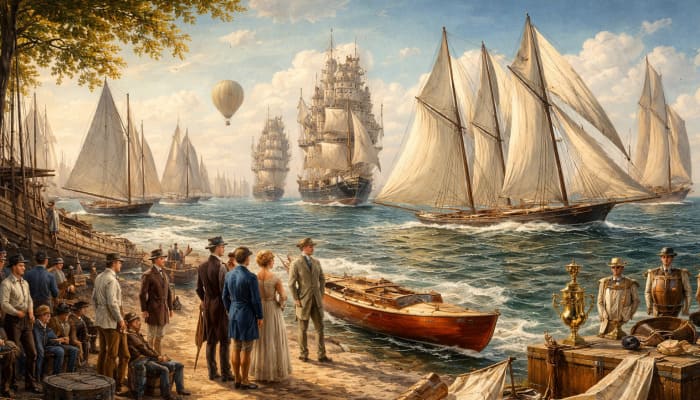
Sailing did not originate as a form of entertainment, but rather as a necessity. As far back as 5,000 years ago, the ancient Egyptians, Phoenicians, and Polynesians used sails for trade, exploration, and conquest.
The transformation of sailing vessels from working tools to competitive vehicles took place in 17th-century Holland, from where the craze spread to England. The first officially documented regatta took place in 1661 on the Thames, and in 1851, the legendary race around the Isle of Wight took place, marking the beginning of the America’s Cup, the oldest international competition still in existence today.
Sailing was included in the Olympic Games program in 1900 in Paris and has been an integral part of the competition ever since (except for 1904). During this time, yacht classes have changed many times, reflecting technological progress. The International Sailing Federation (World Sailing) was founded in 1907 and today brings together more than 140 national federations.
International structure:
- World Sailing (WS) is an international federation that sets rules and standards.
- The All-Russian Sailing Federation (VFS) is the governing body in Russia.
- The world’s largest regattas: America’s Cup, Ocean Race, Vendée Globe, Fastnet Race.
Sailing actively developed in Russia under Peter I. The first official club appeared in 1718 (the Hereditary Nevsky Fleet). Soviet and Russian yachtsmen have repeatedly won Olympic and world championships. Today, major regattas are held in the Gulf of Finland, Ladoga, Sochi, and Crimea.
Russian achievements in sailing
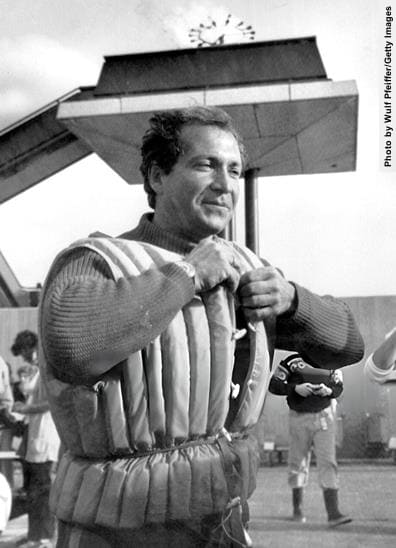
Russian sailors have repeatedly climbed onto the Olympic podium:
Valentin Mankin is a legend of Soviet sailing and the only sailor in history to have won gold in three different classes (1968, 1972, 1980).
Viktor Potapov — bronze medalist at the 1972 Olympics in the Finn class.
Georgy Shayduko — silver medalist at the 1996 Olympics in the Soling class.
In the 21st century, Stefania Elfutina achieved success, winning a bronze medal for Russia in the RS:X windsurfing class at the 2016 Games in Rio de Janeiro.
Interesting fact! Fyodor Konyukhov is a unique personality. He is not only a yachtsman, but also a professional traveler, artist, and priest. He was the first person in the world to sail solo around the world without stopping at any ports in a rowing boat, setting many maritime records.
The diversity of the discipline: classification of races
Sailing is remarkable for its variety of formats, which can be classified according to different criteria:
- By type of vessel: from miniature dinghies (up to 3 m) to giant maxi yachts (over 30 m), from strict monotypes (single class) to high-tech catamarans.
- By composition: single-handed sailing, team regattas, mixed or age-group crews.
- By distance: short coastal races or multi-day ocean marathons.
- By format: mass start fleet races, match races (yacht duels) or team tactical races.
How competitions work
A standard regatta includes about 7 races in each yacht class. The scoring system encourages competition for the lead: first place gets 0 points, second place gets 3 points, third place gets 5.7 points, and so on, up to 11.7 points. Only the top 6 places count toward the overall score.
Key formats:
- Fleet races: classic mass start. The winner is the first to finish (in one-designs) or the best in corrected time (taking into account the yacht’s handicap).
- Match race: an intellectual duel between two crews, where tactics to block the opponent are no less important than speed.
- Team races: a relay or simultaneous start of several yachts from each team, where the result is determined by the combined effort.
Equipment: functionality and tradition
- Clothing: from simple shorts for warm waters to high-tech waterproof suits for the ocean.
- Footwear: soft moccasins with non-slip soles or waterproof boots.
- Accessories: protective gloves, sunglasses, headgear.
- Yacht. The main, but not mandatory investment to get started — many clubs offer boats for rent.
From what age and how much does it cost?
- Getting started: The optimal age to start is 7-10 years old. Many clubs accept children from 6-7 years old, starting with theoretical training and lessons on small, safe Optimist class yachts. There are no age restrictions for adults — you can start at any age.
- Cost: Sailing is traditionally considered expensive, but there are different ways to get started.
- Children’s sports schools (state-run): Classes are often free or require a minimal fee. The main problem is high competition for places and the need for equipment.
- Private clubs and sections: The cost of group training can range from 15,000 to 40,000 rubles per season (summer). Individual training is more expensive.
- Main expenses: Equipment (life jacket, wetsuit, shoes — from 30,000 rubles), as well as participation in competitions (travel, fees). At the initial stage, many clubs provide equipment.
Interesting fact! The youngest solo sailor to cross the Atlantic Ocean is Laura Dekker from the Netherlands. She accomplished this at the age of 14 (after lengthy legal battles for permission).
Live beautifully: Sailing
Conclusion
Sailing is a school of life on the water. It teaches responsibility, independence, decision-making in rapidly changing conditions, and respect for the elements. It is a sport where girls and boys, young men and women compete on equal terms, and careers can last for decades.
Today, after going through some tough times, sailing in Russia is growing fast: new marinas are being built, modern fleets of training yachts are popping up, and amateur interest in regattas is coming back. This opens the door for new generations of sailors who are just waiting to write their names in history alongside Valentin Mankin. The main thing is to take the first step: find the nearest yacht club, come to an open house, and experience the incomparable feeling of the sail filling with wind as the yacht rushes forward toward the horizon.