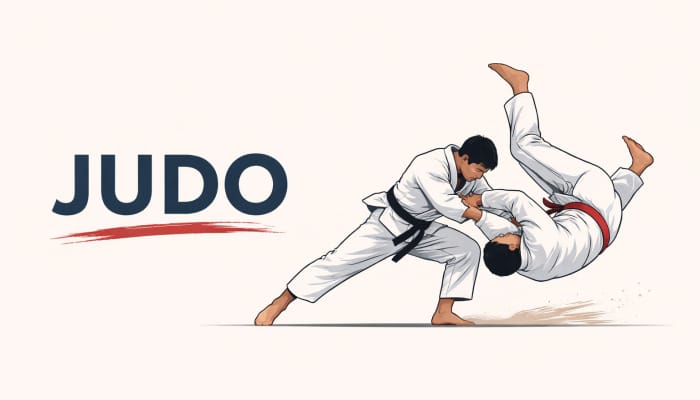
Judo: how this martial art came about, what principles it is based on, how matches are conducted, and how techniques are evaluated. Discover the path to harmony of body and spirit.
#Judo #MartialArts #TypesOfSports
Judo is a Japanese martial art whose history is well known, unlike many other martial arts. Its roots lie in jujutsu (jiu-jitsu), a system of unarmed combat where skill lay in using an opponent’s strength against them. Jujutsu flourished in the 17th–19th centuries, when it was part of the mandatory training of samurai.
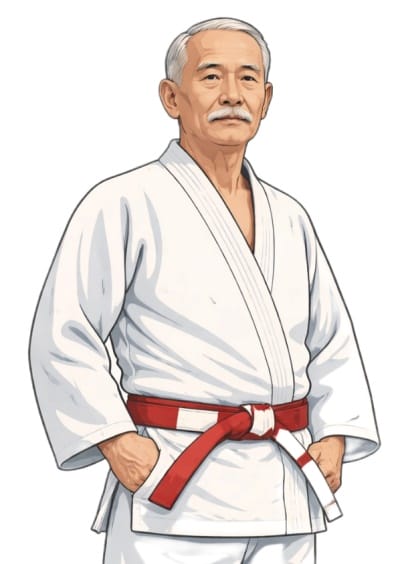
At the end of the 19th century, a young scientist named Jigoro Kano systematized and reformed this art. He selected the best techniques from different schools, excluding the most dangerous ones, and created a new system, calling it “judo,” which means “gentle (or flexible) way.” In May 1882, Kano founded the first judo school in Tokyo, the Kodokan (“House of Learning the Way”), marking the beginning of the worldwide spread of this martial art.
Interesting fact! Jigoro Kano, the founder of judo, is the only athlete and coach in Japan whose image appears on a national banknote (from 2024 on the new 1,000 yen note).
The path of judo in the world of sports
Judo developed rapidly:
- Just four years after its founding, it received official recognition in Japan.
- In 1900, the first rules for international competitions were developed.
- Jigoro Kano actively sent his students around the world to give demonstration performances.
Over time, the physical and athletic aspects of judo began to prevail over spiritual practice. Important milestones included:
- 1951 — the International Judo Federation (IJF) was created.
- 1956 — the first world championship was held in Tokyo.
- Weight categories were introduced for athletes.
- 1964 — inclusion of judo in the Olympic Games program.
- 1992 — women’s competitions debuted at the Barcelona Olympics.
- Split: Today, traditional judo (with an emphasis on philosophy and self-defense) and sports judo (with an emphasis on competition and spectacle) are developing in parallel.
The development of judo in Russia is associated with the name of Vasily Oshchepkov, one of the first Europeans to receive a black belt from Jigoro Kano at Kodokan. Based on judo and other martial arts, Oshchepkov and his followers created sambo. After a period of obscurity in the 1930s and 1950s, judo was revived in the USSR as an Olympic discipline, and Soviet, and now Russian, athletes have consistently been among the world’s elite.
At the 2012 Olympics in London, the Russian team achieved its best team result, winning three gold medals. The names of champions Arsen Galstyan, Mansur Isaev, and Tagir Khaibulaev became known throughout the world. At the 2016 Games in Rio de Janeiro, Beslan Mudranov and Hasan Khamurzaev won gold medals.
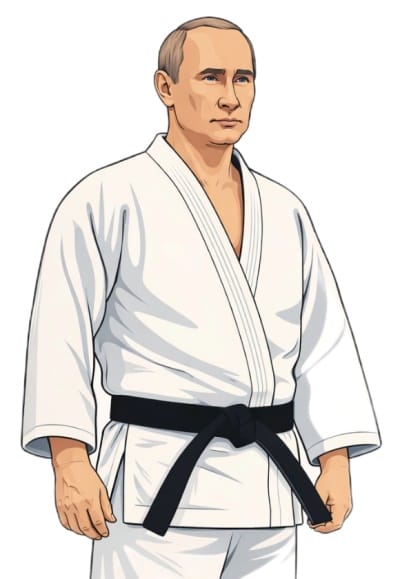
It is known that Russian President Vladimir Putin has been involved in martial arts since childhood. He began training at the age of 11, became a master of sambo at 21, and two years later, a master of judo.
In 2012, Vladimir Putin was awarded an 8th dan (the highest among non-Japanese living today), which corresponds to a red and white belt, for his contribution to the development of judo. During training, he often wears a black belt, which is permitted for holders of high dan ranks. He is the co-author of the textbook “Learning Judo with Vladimir Putin.”
Interesting fact! In judo, competitions are still held in the open weight category, where judokas of any weight can compete. This is a real test of technique against brute force. The famous Yasuhiro Yamashita won the open world championship four times.
Philosophy, rules, and traditions
The spiritual foundation of judo is reflected in the oath that students take when they enroll in school. They promise not to drop out, not to disgrace the school or the art of judo, to keep the secrets of their training, and to follow its rules.
Basic rules and features of the fight:
- Competitions are held on special mats — tatami, consisting of a working area and a safety area of different colors.
- Fights (shiai) last 4 minutes.
- In judo, strikes are prohibited, painful techniques are restricted, but chokeholds are allowed.
- To admit defeat, the athlete taps the tatami with his hand.
- All referee commands are given in Japanese.
Scoring techniques:
Each technique performed is scored by the judges:
- Fall on one shoulder — 7 points (half victory)
- Fall on the side — 5 points
- Fall on both shoulders — 10 points (clear victory or “ippon”)
- Violations of the rules are punished with warnings (shido), and serious violations result in disqualification (hansoku-make).
It is extremely difficult to win a clean victory in professional competitions. The match begins and ends with a mutual bow between opponents, which emphasizes respect for the opponent and for the art of judo itself.
The system of belts and ranks reflects the level of skill:
- Kyu — student ranks (from 6th to 1st), corresponding to belts from white to brown.
- Dan — master ranks. Holders of 1–5 dan wear a black belt, 6–8 dan wear a red and white belt, and 9–10 dan wear a red belt.
Interestingly, according to some sources, the founder of judo, Jigoro Kano, wore a double-width white belt, symbolizing the highest level of mastery. Only 15 people in history have been awarded the 10th dan.
Judo uniforms (training suits) must strictly comply with the rules: the jacket must cover the hips and reach the wrists.
Interesting fact! The belt system is a Western invention. Although it is now an integral part of the image, the colored belt system (kyu and dan) was introduced by Jigoro Kano only in the 1880s for Western students to motivate them. In traditional Japanese martial arts, there were only white and black belts (and sometimes just everyday clothes).
The way of judo
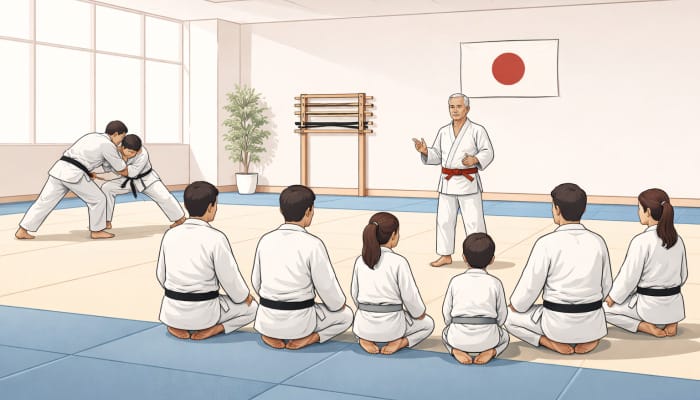
To become a professional judoka, you need to train for at least 10 years. Experts recommend starting training at the age of 8-9, although some schools accept children from the age of 6-7.
Judo is considered one of the most democratic sports—children of different heights, weights, and physical abilities can succeed in it, since the main thing in judo is technique and skill, not strength or size.
After a certain period of training, young judokas can participate in competitions. Matches in the younger age categories last up to 2 minutes, but even in this short time, it is possible to achieve excellent results.
Galileo: Judo
Conclusion
The essence of judo is not in strength, but in artistry. The artistry of using your opponent’s energy, turning weakness into advantage, and finding harmony between body and spirit. From ancient jujitsu techniques to modern Olympic podiums, from the white belt of a beginner to the red and white belt of a master, this is a path open to anyone who is ready for discipline, training, and respect for ancient traditions. This “gentle way” leads not only to sporting victories but also to the development of a strong, balanced personality. Judo awaits all who want to discover these qualities within themselves.