
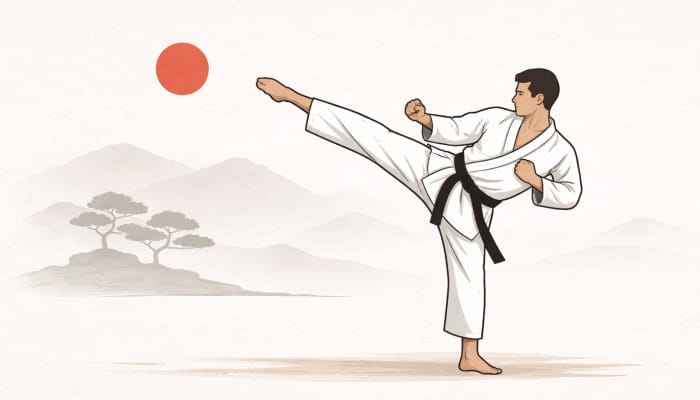
Karate: its origins in Okinawa and Russia, philosophical principles, official WKF rules, requirements for uniforms and protective gear. Recommendations for getting started.
#Karate #Karatedo #TypesOfSports
Karate is not just about breaking boards with your hands or winning sparring matches. For millions of people around the world, it has become a philosophy of life, a discipline of body and spirit. The journey this martial art has taken from the quiet villages of Okinawa to the roar of Olympic stadiums is full of drama and grandeur.
History of karate
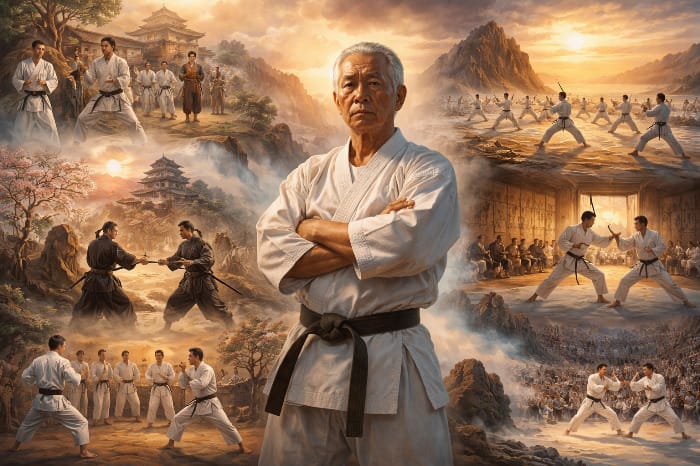
The history of karate is shrouded in legends and mysteries. It is officially considered to have originated on the island of Okinawa (Japan), which was once the center of the independent state of Ryukyu. Due to a ban on carrying weapons imposed by Japanese conquerors, local residents had to develop methods of self-defense using their bare hands.
Initially, this martial art was simply called “To-de” (Chinese hand), which indicates the enormous influence of Chinese wushu. Okinawan masters secretly traveled to China, mixed local fighting techniques with the knowledge they brought back, and adapted them to their own realities.
At the beginning of the 20th century, the great master Gichin Funakoshi brought karate from Okinawa to Japan. It was he who changed the character in the name from “Chinese hand” to “empty hand,” giving it a deep philosophical meaning. This is how the term “Karate-do” — “The Way of the Empty Hand” — was born. In Japan, the art was systematized, acquired sporting elements, and divided into many styles (Shotokan, Goju-ryu, Wado-ryu, and others).
Interesting fact! Today, there are not just a few styles, but more than 230 different karate disciplines and schools around the world, which can differ greatly from each other in terms of technique and rules.
The history of karate in Russia
Karate appeared relatively late in Russia, in the 1970s, but its history is full of drama. The first clubs operated semi-clandestinely, as martial arts were considered “alien to the Soviet people.” Enthusiasts, often students who had studied abroad, brought back films with recordings of fights and literature.
The heyday came in the late 1980s and early 1990s. The legalization of karate caused a real boom: thousands of young people flocked to the gyms. However, the lack of a unified system led to disagreements and the emergence of many federations and styles that did not always get along with each other.
Despite all the difficulties, the Russian karate school has established itself. Today, Russian athletes are among the strongest in the world, regularly winning medals at European and world championships, as well as at the Olympic Games (where karate made its debut in 2020 in Tokyo).
The philosophy of karate
Unlike boxing or wrestling, where the goal is obvious—to defeat your opponent—karate pursues a different goal. It is no coincidence that the prefix “-do” (way) is often added to the name. Karate-do is the way to perfect the spirit through the body.
The main principles include:
- Dojo-kun: Five principles of behavior in the hall (striving for character perfection, loyalty, diligence, respect for others, refraining from rude behavior).
- Zanshin: A state of relaxed readiness, awareness even after the completion of a technique.
- Kihon, Kata, and Kumite: The three pillars of karate. Technical foundation, formal exercises (shadow fighting), and sparring.
The philosophy is based on the principle of “no attack.” Karate techniques are so deadly that using them without extreme necessity was considered shameful. The famous postulate “Karate ni sente nashi” (There is no first strike in karate) means that a true master never attacks first, he only defends himself.
Karate classes teach you to control aggression and instill respect for your partner and teacher. Bowing at the beginning and end of training is not an empty formality, but a tribute of gratitude and a sign of humility. Purification of the mind, concentration, and the ability to find balance in any situation are the true goals of a karateka.
Interesting fact! The force of an experienced master’s punch can reach 700 kg, and a kick can exceed one ton. To build up their striking surfaces, fighters used makiwara (straw bundles) and even buckets filled with beans, sand, or pebbles, training their fingertips until they lost sensitivity.
Karate rules
The rules vary greatly depending on the version (traditional WKF sports karate, contact versions such as Kyokushin, or American full-contact karate). The most common rules in the world are those of the World Karate Federation (WKF), under whose auspices the Olympic Games are held.
The main aspects of the WKF rules are as follows:
- Control: Strikes must be controlled. It is forbidden to cause injury. The athlete must stop the strike one centimeter from the target.
- Target areas: Head, neck, abdomen, chest, back.
- Scoring (Yuko):
- Ippon (3 points): Kick to the head or body, knocking down the opponent and following up with a finish.
- Waza-ari (2 points): Kick to the body.
- Yuko (1 point): Any punch to the body, head, or neck.
- Prohibited: Grappling for more than 2-3 seconds, strikes to the groin, joints, with an open glove (open hand), dangerous throws and attacks while falling.
In contact styles such as Kyokushin, strikes to the head with the hands are prohibited, but low kicks and full-contact strikes to the body are allowed, which makes the fights more intense and spectacular.
Karate equipment
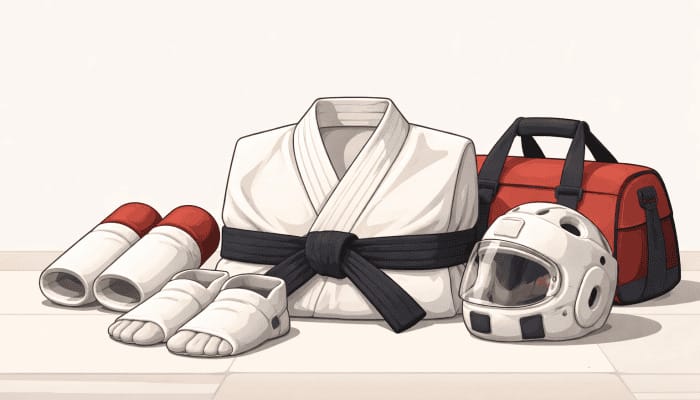
Karate equipment is traditional and ascetic, but has its own strict rules:
Karate gi (kimono): A white suit for training and competitions. There are special reinforced models for kata competitions and lightweight models for kumite. Belt (obi) — a symbol of skill, its color indicates the student’s level of training (from white to black).
Protective gear (for kumite): A helmet (for juniors), gloves (fists), chest protection (for women), a cap, a bandage, as well as shin and foot protectors (foot protectors) are mandatory.
Pads and makiwara: Used to practice striking power in the gym.
It is noteworthy that in classical schools (traditional karate), protection is not used so that the fighter does not lose their sense of distance and danger.
Interesting fact! There is a harsh legend about the origin of belt colors in old Okinawan karate. According to it, the white belt of a beginner darkened from sweat, turning yellow, and when the student was allowed to spar, it became soaked with blood, turning red and then brown. The black belt of a master is the result of many years of sweat, dirt, and blood.
At what age should one start practicing?
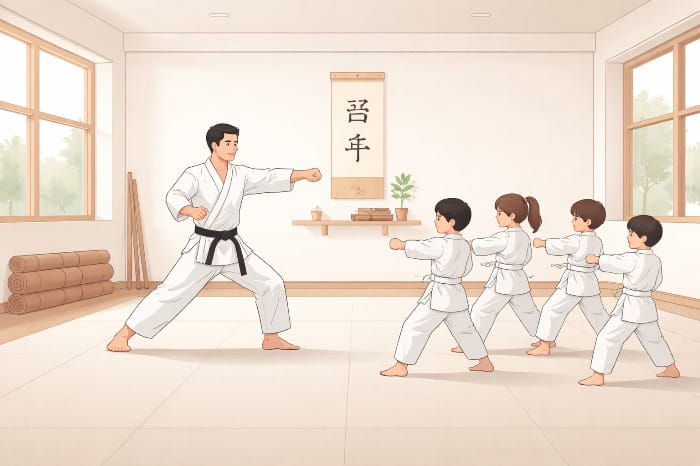
Karate is unique in that it can be practiced at any age, but the goals will be different for each age group.
Children (4–6 years old): This is the age for general physical training and discipline. The main task is to develop coordination, teach how to fall, and listen to the coach. At this age, children are taught to greet each other on the tatami, not to hit each other.
Children (7–12 years old): This is the golden age for learning basic techniques (kyon). Children absorb movements like a sponge. This is where muscle memory is laid down for life.
Teenagers and adults: You can start from scratch at 20 or 40 years old. For adults, karate is a way to keep the body in shape and achieve psychological balance.
Veterans: Many masters continue to practice kata (where there is no risk of injury) into old age.
The main condition is the absence of medical contraindications and a strong desire.
Japanese karate
Conclusion
Karate is a universal tool for personal development. In today’s stressful and aggressive world, karate teaches you to control your emotions, protect yourself and your loved ones, and build character. Whether you plan to become an Olympic champion or simply want to stay in shape, you can always find your own “Way” in this ancient but eternally young art.