Sport shooting: history, disciplines, and types of weapons. Learn about records, safety, and why a rifled barrel provides phenomenal accuracy.
#Shooting #SportShooting #SummerSports
Sport shooting is not just a competition in accuracy, but a whole philosophy combining centuries-old traditions, high technology, and incredible endurance on the part of the athlete. This sport requires not only physical training, but also the ability to completely control one’s emotions, concentrate, and analyze the smallest details of the surrounding environment. Unlike many other disciplines, here silence and calm can be louder than a gunshot.
From muskets to Olympus: the history of marksmanship
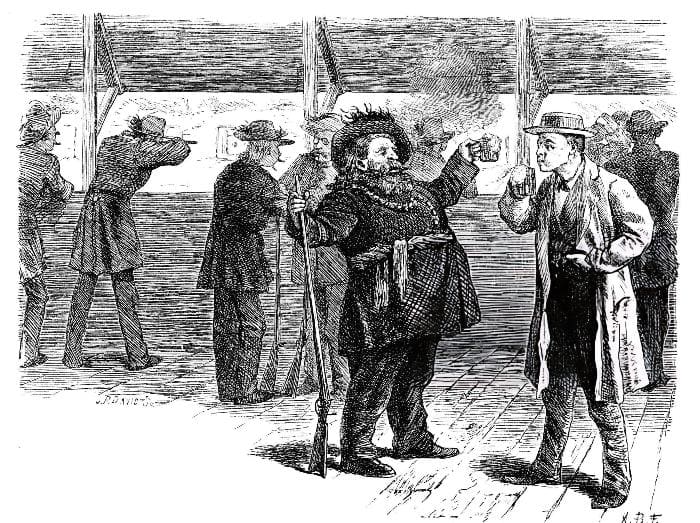
The history of sport shooting dates back to ancient times, when people competed in accuracy with bows and crossbows. With the advent of firearms in the 14th century, it quickly attracted the attention of not only the military and hunters, but also athletes.
The first sporting models were smoothbore shotguns, and by 1896, rifle and pistol shooting had been included in the program of the first modern Olympic Games in Athens.
Interesting fact! Women first competed in shooting at the Olympics back in 1900 in Paris, making this sport one of the earliest to be open to women.
Russian shooting school: traditions and leadership
Russia occupies one of the leading positions in world shooting sports. This tradition was established back in the 1930s with the introduction of the title “Voroshilov Shooter.”
Today, Russian athletes hold five current Olympic records (Sergey Kamensky, Alexander Melentyev, Boris Kokorev, Mikhail Nestruev, Alexey Klimov), and in terms of the total number of Olympic medals, the USSR/Russia confidently holds second place after the USA.
Our country has unique clubs, such as the world’s largest, “Object” or “Shot,” where sand bullet traps are used for safety.
Interesting fact! A career in shooting can be very long, as experience and honed technique are important here. For example, Italian Giovanni Pellielo competed in eight Olympic Games (1992-2020) and won four medals, the last one at the age of 50.
Safety and the philosophy of sport
Despite the use of weapons, sport shooting is one of the safest sports, with no accidents involving weapons recorded in the entire history of competition. This sport develops not only accuracy, but also the highest level of discipline, concentration, endurance, and willpower. Shooters learn to take into account the smallest details: changes in lighting, wind strength, and their own stability.
Disciplines: bullet and saucer
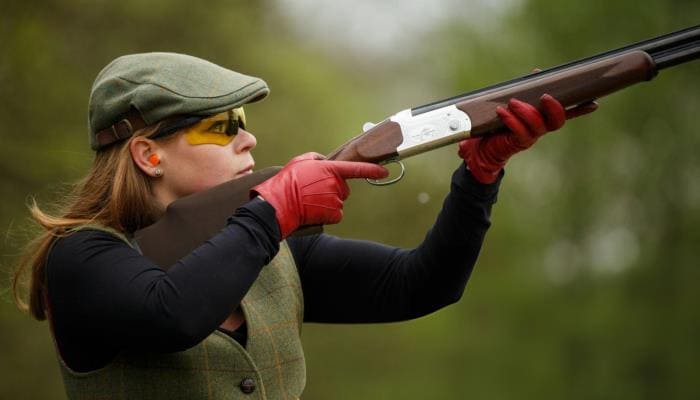
Modern sport shooting offers 17 Olympic disciplines, which are divided into two main categories:
– Bullet shooting: conducted with rifled weapons (rifles, pistols) at stationary or moving paper targets.
– Trap shooting: shooting with smooth-bore guns at flying clay targets, imitating hunting situations and requiring phenomenal reaction times.
Despite the use of weapons, this sport is often compared to chess in terms of the level of control and concentration required.
Weapons and equipment
Each discipline requires special weapons, which are often custom-made for each athlete. The arsenal includes:
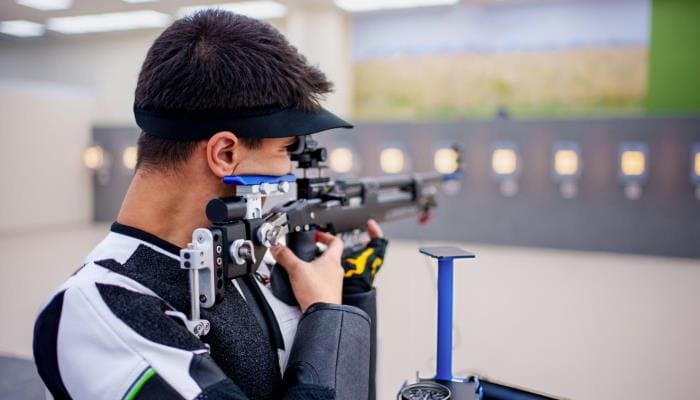
- Air guns (rifles and pistols), which young athletes usually start with at the age of 12. Thanks to a complex system of compensators and muzzle brakes, modern air rifles have almost no recoil. The bullet is propelled by compressed air, and the weapon remains stationary.
- Rifled weapons (rifles and pistols of various calibers) for bullet shooting. Olympic weapons use the most advanced materials: aviation aluminum, carbon fiber, titanium alloys. The trigger mechanism can be adjusted with gram precision.
Smoothbore guns (often with vertically arranged barrels) for trap shooting. - Footwear for stability. Rifle shooting boots have flat, non-flexible soles with spikes to keep the foot as stable as possible. They can be adjusted for angle.
- The suit is a “rigid frame”. A shooting suit made of particularly dense fabric (weighing up to 2.5 kg) restricts movement and dampens body vibration, creating a “human tripod.”
Interesting fact! Rifles for prone shooting or shooting from three positions can weigh up to 8 kg or more. This is not for convenience, but for stability: heavy weapons are less susceptible to micro-shaking of the hands.
The main secret: why does a bullet spin?
The key difference between rifled weapons and smoothbore weapons is the rifling in the barrel. This causes the bullet to spin around its axis. This rotation turns it into a gyroscope, stabilizing its flight.
- A modern bullet with a sharp nose “cuts” through the air, experiencing minimal resistance.
- The rotation prevents it from tumbling, forcing it to fly strictly point-first along a given trajectory, regardless of wind and turbulence.
This is why rifled weapons are significantly more accurate than smoothbore weapons, which historically used round bullets that quickly lost speed and stability in flight.
Where does a shooter’s journey begin?
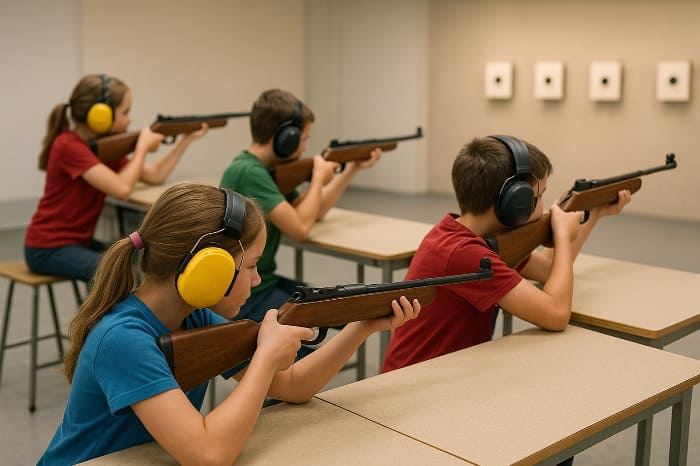
Children can join special sports shooting clubs from the age of 12. Training always begins with safety basics and so-called “dry” training—practicing how to hold the weapon, aim, and pull the trigger without a cartridge. The first weapon for a young athlete is usually an air rifle or pistol.
General physical training also plays an important role. To develop endurance, coordination, and nervous system stability, future champions are recommended to take up skiing, swimming, cross-country running, or table tennis.
Sports technology: sport shooting
Conclusion
Sport shooting is much more than just a competition in accuracy. It is a centuries-old tradition that has evolved into a high-tech sport where triumph is born at the intersection of human skill and engineering. From ancient bows to modern rifled rifles, man’s quest for perfection in marksmanship has come a long and glorious way, culminating in Olympic status and worldwide recognition.
This sport challenges not only physical abilities but also strength of spirit. It teaches extreme concentration, composure, and the ability to control every movement and breath. Behind the apparent static nature of the shot lies enormous internal work, tactical calculation, and years of persistent training. As history shows, Russia has made an invaluable contribution to the development of this discipline, nurturing a galaxy of champions and setting world standards of excellence.