
Taekwondo: from ancient roots and philosophy to modern Olympic rules. We will tell you about the history, rules, belt system, and secrets of breaking hard objects.
#Taekwondo #SummerSports
Taekwondo is not just a Korean martial art, but a whole philosophy, tempered in battle and embodied in movement. Behind the spectacular jumps and breaking boards lies centuries of history, rigorous science, and deep spiritual discipline.
History: from ancient traditions to Olympic recognition
Taekwondo is a harmony of three components: “tae” (kick), “kwon” (fist or punch), and ‘do’ (way, art, method). Thus, the name can be translated as “The Way of the Foot and Fist”.
Archaeological finds, such as wall paintings in the royal tombs of Goguryeo, depict warriors in stances and techniques strikingly similar to those used today. These images are about 2,000 years old, proving the existence of ancient hand-to-hand combat systems known as “subak” and “taekkyeon.” .
Despite its ancient roots, taekwondo in its modern form was systematized and named only on April 11, 1955. This date is considered the official birthday of taekwondo.
After the Korean War, the government of the Republic of Korea initiated a project to create a unifying national martial art. Young General Choe Hong Hi (also known as Choi Hong Hi) systematized the techniques of various schools, added a scientific approach to the biomechanics of strikes, and created taekwondo as we know it today. In 1966, he founded the International Taekwondo Federation (ITF).
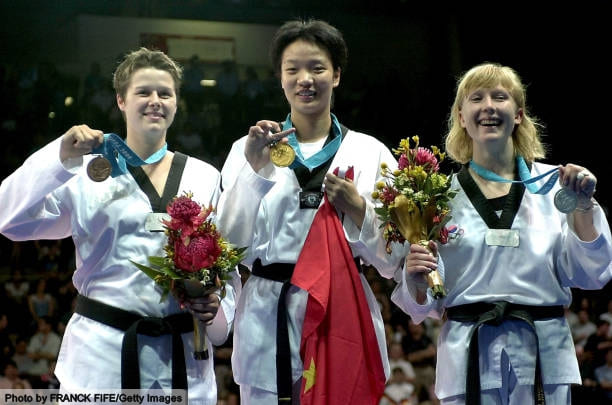
The new art quickly spread around the world. In 1973, the World Taekwondo Federation (WT) was created, which contributed to its sportification. And in 2000, taekwondo made its debut as an official Olympic sport at the Sydney Olympics. At those games, Russian athlete Natalia Ivanova won a silver medal.
Interesting fact! Taekwondo is known as the art of high and complex kicks. It uses the widest range of kicks among all Olympic martial arts (roundhouse, side, back, spinning, jumping).
Philosophical core: five principles
Technique in taekwondo is inseparable from spiritual development. All practitioners follow five basic principles:
- Courtesy (YE UI).
- Honesty (YOM CHI).
- Perseverance (IN NAE).
- Self-control (GUK GI).
- Indomitable spirit (BAEKJUL BOOLGOOL).
These commandments shape the character of the athlete both inside and outside the dojang (training hall).
Taekwondo disciplines
The competition program demonstrates all aspects of skill:
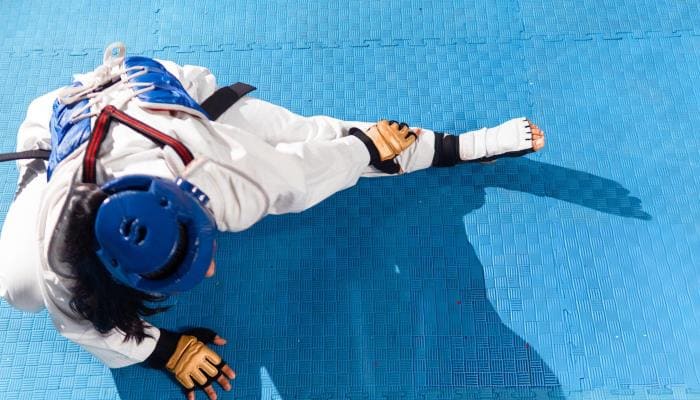
- Kyorugi (sparring). A dynamic duel in protective gear (helmet, vest). Kicks are allowed to the head and torso, punches only to the torso. Points are awarded for accurate and technical attacks. The match consists of 3 rounds of 2 minutes each.
- Pumsae (formal complex). An exercise against imaginary opponents, consisting of a strict sequence of strikes, blocks, and movements. Demonstrates accuracy, balance, and control. There are 24 basic poomsae, symbolizing the 24 hours in a day.
- Waryeok (board breaking). A test of power, concentration, and technique. A standard board is 1.5-2 cm thick. Athletes perform a series of strikes (with their hands and feet), aiming to break as many boards or slabs as possible with a single strike.
- Tuk-ji (special technique). The most spectacular test, where you have to break a board fixed at a considerable height (sometimes several meters) in a jump and land cleanly.
Belt system: the ladder to perfection
The level of skill in taekwondo is visually reflected in the color of the belt (ti). The system includes:
- 10 “kyups” (student ranks). The path begins with a white belt, symbolizing purity and potential, and through yellow, green, blue, and red leads to brown/black-red, signifying readiness for mastery.
- 10 “dans” (master degrees). Holders wear a black belt. Each subsequent dan requires not only technical growth, but also contribution to the development of taekwondo, teaching experience, and maturity of spirit. The intervals between the awarding of dan grades can be up to several years. The highest dan grades (7th to 10th) are awarded for lifetime achievements.
Interesting fact! Most modern training uniforms (doboks) have a V-shaped neckline. This neckline symbolizes “ipsun,” a Chinese character meaning “human.” It serves as a reminder that taekwondo is a path to becoming a harmonious person, not just a way to fight.
Secrets of Tameshiwari (Kyokpa)
The art of breaking hard objects is not magic, but a combination of physics, physiology, and years of training.
- Preparation of striking surfaces. The bones (especially the knuckles of the index and middle fingers when striking with a fist) and the edge of the palm are compacted and strengthened with special exercises. The muscles and ligaments of the hand are transformed into a powerful shock absorber.
- Technique and speed. The strike is delivered strictly perpendicular to the target surface so that the force is distributed over the minimum area, creating maximum pressure. Speed is key, not just muscle strength. The hand or foot should pass through the target, not stop on it.
- Mental concentration (“kikhap”). A sharp kick (“kikhap”) at the moment of impact not only mobilizes energy and increases muscle tension, but also helps to focus the mind, blocking pain and fear.
- Material properties. Materials with a pronounced fibrous structure (pine, spruce) are used, which split along the grain. Bricks are often laid with gaps, which reduces resistance.
Important! Attempts to repeat the breaking without many years of training under the guidance of an experienced instructor will inevitably lead to serious injury.
Taekwondo in the modern world
Today, taekwondo exists in two main formats:
- WTF (World Taekwondo Federation) — Olympic style, with an emphasis on fast, high kicks in dynamic sparring using electronic vests.
- ITF (International Taekwondo Federation) — a more traditional style with powerful strikes and complex formal patterns (tul).
But the essence remains the same. In an era of digital distractions and clip thinking, taekwondo offers a unique space for digital detox. It’s an hour a day when you are alone with your body and your breath, honing your movements to perfection, learning to fall and get up. It’s meditation in motion.
The journey of a lifetime
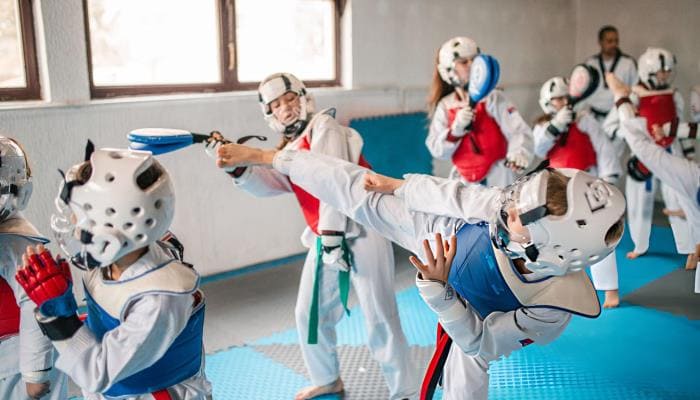
Taekwondo is an art for all ages. For children, it is a school of discipline and confidence, a channel for energy. For adults, it is a tool for stress management, physical fitness, and constant self-challenge. For the elderly, it is a practice for maintaining flexibility, mental acuity, and connection with the life force.
Ultimately, taekwondo is a path to oneself. A path where every kick dispels inner doubts, every block stops external negativity, and every bow reminds one of humility and respect. It is not just a martial art. It is the art of living with conscious strength and a calm spirit.
You can start practicing taekwondo at the age of 4-5 in health groups. Serious sports training and the first certifications begin at around 7-10 years old. From the age of 15, athletes can apply for adult master degrees (dan).
Taekwondo
Conclusion
Taekwondo is a multifaceted phenomenon that harmoniously combines centuries-old wisdom with the dynamics of modern sport. It begins as a path to physical development, but gradually reveals itself as a profound philosophical system that builds character. From ancient frescoes depicting the first warriors to Olympic podiums, taekwondo has evolved while retaining its essence: discipline of mind, strength of spirit, and perfection of technique.
This art demonstrates that true strength comes not from aggression, but from self-control, concentration, and respect—for oneself, one’s opponent, and tradition. The principles of courtesy, honesty, and perseverance that underlie it extend far beyond the sports hall, becoming a code of life for millions of followers.