
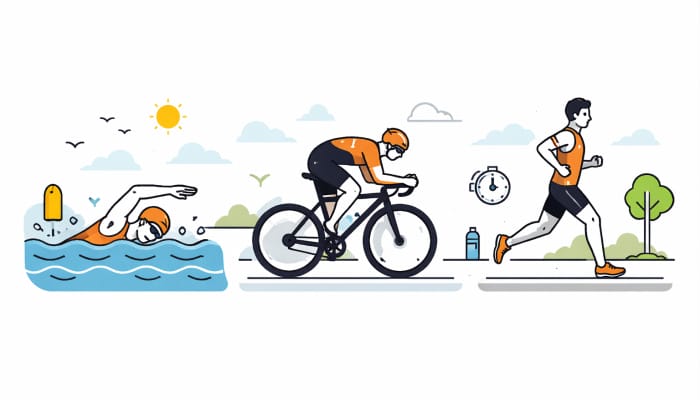
A triathlon is not just a race, but three challenges in one. History, race classification, a summary of the main rules, and practical recommendations for beginners.
#Triathlon #Ironman #TypesOfSports
Triathlon is not just a sport, but a severe test of human capabilities, a multisport race in which participants must complete three stages without pause: swimming, cycling, and running. Although there are different variations of this sport, the Olympic standard is recognized as the combination of swimming, cycling, and running. Competitions are held both on approved international distances and on a variety of local tracks.
History of Triathlon
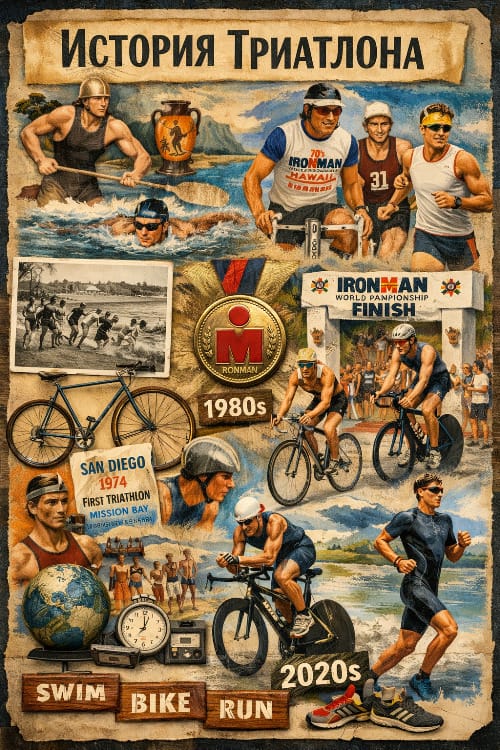
The historical birthplace of triathlon is the French town of Melun. It was there, in the 1920s, that a competition called “Les Trois Sports” (“Three Sports”) was held. Participants had to run 3 km, cycle 12 km, and swim across the Marne River.
The idea proved contagious: similar events soon appeared in Marseille and Poissy. However, these races did not gain real sporting recognition, and by the 1930s, European triathlon had been forgotten.
In the late 1960s, America was gripped by a real running fever. In California, the San Diego Track Club was looking for ways to diversify its training and came up with the idea of combining cyclical disciplines. This is how the format we are familiar with today was born: swimming, cycling, and running.
The name “triathlon” was chosen by analogy with classic multisport competitions (pentathlon, decathlon), combining the Greek words ‘treis’ (three) and “athlos” (competition).
The official date of birth of the sport is considered to be September 25, 1974. On this day, the first race took place in Mission Bay (San Diego), where 46 daredevils swam 500 meters, cycled 8 km, and finished with a 10-kilometer cross-country run.
Among the participants were husband and wife Judy and John Collins. Four years later, they organized a race that was destined to become legendary — the Hawaiian Ironman. The distance, which included a 3.8 km swim, a 180 km bike race, and a marathon (42.2 km), became the benchmark for “iron” endurance and later turned into a world championship.
Interesting fact! During a full Ironman race, a professional athlete can burn between 8,000 and 10,000 calories and lose up to 3-4 liters of fluid through sweat alone.
The popularity of this new sport grew rapidly. In 1982, the United States Triathlon Association (USTA) was founded, thanks to which the number of races in the country exceeded 1,500 per year. And in 1989, the International Triathlon Union (ITU) was founded, establishing uniform rules. It was under the auspices of the ITU that triathlon made its triumphant debut in the Olympic Games program in Sydney in 2000, with a 1.5 km swim, 40 km bike race, and 10 km run.
In Russia, triathlon is currently experiencing a real boom. From Moscow to Vladivostok, dozens of races are held under the auspices of IRONSTAR, TITAN, the triathlon federation, and local organizers. Infrastructure has appeared: velodromes, outdoor pools with lanes for timed swims.
The main problem is the short season and the climate. Athletes have to prepare for summer races in gyms on exercise bikes and in swimming pools. But this only strengthens their character. Russian amateurs are famous worldwide for their endurance, and this is no coincidence.
Standard distances
Modern triathlon offers athletes a wide range of distances:
- Super Sprint: 300 m swim, 8 km bike, 2 km run. This format has been used in the Olympic mixed relay since 2021.
- Sprint: 750 m + 20 km + 5 km.
- Olympic (standard): 1.5 km + 40 km + 10 km.
- Half Ironman (70.3 miles / 113 km): Everything is doubled here: 1.9 km swim, 90 km bike stage, and half marathon (21.1 km).
- Full or Ironman distance (140.6 miles / 226 km): The hallmark of the Hawaiian championship — 3.8 km swim, 180 km bike ride, and marathon (42.2 km).
Interesting fact! During a race, an athlete’s heart rate can remain at 150–170 beats per minute for 8–17 hours (depending on training and distance). During this time, the heart pumps tons of blood.
Types of triathlon
The classic summer triathlon takes place in open water and on the road. The start can be mass (as in the Olympics) or in waves (groups by age or fitness level).
An important technical difference: on short distances (Olympic and sprint), athletes are allowed to draft — riding behind the leader in the peloton to save energy. On “half-iron” and “iron” distances, drafting is prohibited by the rules.
Summer triathlon has a more extreme version — cross triathlon, where the cycling stage takes place on mountain bikes over rough terrain, and the running stage becomes trail running.
There is also a winter triathlon, which includes running on snow, mountain biking, and cross-country skiing, and an indoor triathlon, which is held indoors: swimming in a pool, and cycling and running stages on exercise machines.
Equipment: your tricks
Interestingly, triathlete equipment is a whole different story. Wetsuits are special (“wet”) so as not to restrict movement. Bicycles for long races are equipped with aerodynamic “sun loungers” on the handlebars so that your back doesn’t get sore after many hours. And running shoes are often made without seams so that athletes can run without socks and not lose seconds in the transition zone.
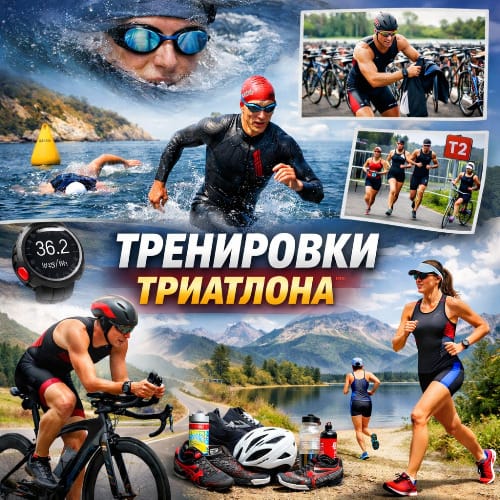
Preparing for such races is a science. If you don’t have four hours a week to train or the budget for proper equipment, it’s better to wait. You need to learn to listen to your coach and your body. Usually, the week is built around one long training session on the weekend and alternating loads on weekdays. A couple of months before the start, “brick training” (cycling immediately followed by running) is introduced into the program so that the body remembers what it’s like to move your legs after sitting in the saddle for many hours.
Interesting fact! In the early days of triathlon, changing clothes was not mandatory. Some athletes would get out of the water, get on their bikes, and run in the same swimsuits they had been swimming in. Nowadays, athletes can be disqualified for “inappropriate attire” on the course, but transition areas are still places where you can see athletes looking rather ridiculous (for example, in wet wetsuits up to their waists, trying to put on socks).
Triathlon: At what age should you start?
The answer to the question “from what age” is deceptively simple: at any age. But with one caveat — the goals must correspond to the biological age.
Triathlon provides harmonious development for children and adolescents (aged 7–10). Instead of one-sided training (only soccer or only wrestling), children learn to coordinate their bodies in a comprehensive way: running develops the skeleton, swimming shapes posture and breathing, and cycling teaches balance and discipline. It is the ideal antidote to physical inactivity without the risk of early “professional” injuries.
For adults (20-40 years old), it is a way to “reboot” the body, which is constricted by an office chair. Triathlon is not about exhaustion, but about rhythm. The change of activities forces all muscle groups to work and teaches you to feel your body anew, releasing accumulated stress with every kilometer.
For those over 50, 60, and older, triathlon is an elixir of youth. Contrary to stereotypes, joints do not “wear out” from movement, but from lack of it. Swimming relieves pressure on the spine, cycling maintains vascular tone, and running (or brisk walking) stimulates lymph flow, preventing stagnation. It is a sport that extends the “shelf life” of the heart and mind.
Triathlon – a sport for the strong-minded
Conclusion
Triathlon has come a long way from its amateur beginnings on the Marne River to becoming one of the most prestigious Olympic sports and one of the most grueling extreme races in the world.
Combining the power of swimming, the speed of cycling, and the willpower of running, it demands total dedication from its participants. But the reward for your efforts is an incomparable feeling of accomplishment, which even the icy fjords of Norway and the volcanic trails of Hawaii cannot match. If you are ready to challenge yourself, the triathlon is waiting for you at the starting line.