
There is a world of amazing details behind the scenes of victories and records. Discover 15 little-known facts about sports in the new issue of our column “Did you know what?”
Interesting facts from the world of sports
 Belov Cup: a torch connecting the epochs. In 2017, the VTB United League not only updated, but radically rethought the design of the Belov Cup.
 The new trophy, made in the form of a stylized torch, is a direct reference to the historical moment when legendary Soviet basketball player Sergei Belov lit the flame of the 1980 Moscow Olympics.
The image of Belov himself is engraved on the surface of the cup at the time of his famous throw in the final of the 1972 Olympic Games against the US national team. Thus, the trophy became a tangible symbol of the connection between Belov’s two greatest achievements: a sporting triumph and Olympic honor.
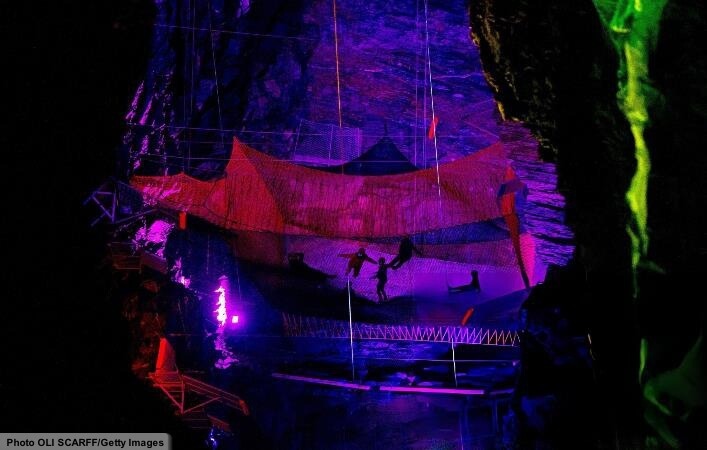
 Bounce Below: The underground world of jumping. The world’s largest trampoline Bounce Below is located in Wales (UK) not just in a building, but in the space of an abandoned slate quarry, turned into a fantastic underground cave.On its giant grid stretched at a height of 25 meters (which is comparable to an 8-storey building), up to 30 people can frolic at the same time. The complex consists of three levels of interconnected trampolines, creating an incredible gaming environment reminiscent of a scene from a science fiction movie.
- Trampoline efficiency: cardio without impact. Trampolining is not just entertainment, but highly effective cardio and lymphatic drainage training. Just 10 minutes of active jumping is equivalent to a 30-minute jog in terms of energy consumption. The key advantage is the minimal load on the musculoskeletal system: due to the shock absorption of the mesh, the impact on the joints and spine is reduced by 4 times compared to running on a hard surface, which makes this type of activity ideal for recovery and injury prevention.
- Water polo caps: a color strategy. The separation of caps by color in water polo is a carefully thought — out visual communication system that is critically important in a dynamic game with constant contact underwater. It allows judges, players and spectators to instantly identify the athlete’s identity. Traditionally, the field team at home wears white caps, while the guests wear blue ones. Red caps are assigned to goalkeepers, which emphasizes their special status and distinguishes them from field players, since they have unique rules (for example, the ability to touch the ball with both hands and push off the bottom in the deep part of the pool).
- Hungary’s stealth kayaks at the Rio Olympics. At the 2016 Olympic Games in Rio de Janeiro, Hungarian rowers applied a technological innovation borrowed from the Navy. Their kayaks were coated with a special microstructured compound that significantly reduced turbulence and friction on the water, creating a “gliding” effect. This technology, similar to coating the hulls of submarines, was one of the factors that allowed the Hungarian national team to win three gold medals, confirming the importance of scientific developments in modern high-performance sports.
 Dragon Boat Racing: A symphony of synchronicity. Dragon boat racing, a popular team sport in Asia, is not just rowing, but a cultural ritual that requires absolute coherence.
 Unlike academic rowing or canoeing, where there are individual disciplines, a boat up to 12.5 meters long accommodates 20, 40 or even 50 rowers, a drummer who sets the rhythm, and a helmsman. The key to victory is the perfect synchronicity of all strokes, turning a diverse group of people into a single living mechanism. It values not so much individual power as collective harmony.
- The evolution of football goals: from simple racks to a “frame”. At the dawn of football, the goal consisted of only two vertical posts without a crossbar. Any ball hit between them at any height was considered a goal, which often provoked disputes. The turning point came in 1875, when it was decided to add a horizontal bar (crossbar) at a height of 8 feet (2.44 m). This innovation not only standardized the rules, but also radically changed the tactics of the game, making goal-kicking a separate art and putting an end to endless discussions about goal-taking.
- Zenit’s record streak: a new era in the VTB United League. In the 2024/2025 season, Zenit Basketball Club (Saint Petersburg) set a historic record in the VTB United League by winning 25 consecutive regular season championships. This series surpassed the previous record held by CSKA Moscow (24 wins in the 2022/2023 season). Zenit’s achievement highlights not only the highest level of the team, but also the growing competitiveness of the league as a whole, where the dominance of one strong team has become even more elusive.
- The specifics of salaries in the NHL playoffs: motivation through bonuses. The National Hockey League (NHL) operates a unique financial system during the playoffs. The players do not receive their usual monthly salary, as their contracts are for the regular season. Instead, there is a general prize pool (formed from the league’s income), which is distributed among the clubs depending on the stage reached. The further the team progresses, the more money each of its players and staff receives. This creates a powerful collective financial motivation to fight for the Stanley Cup.
 The philosophy of the name “UEFA Conference League”. The choice of the name “UEFA Europa Conference League” was deeply symbolic. The word “conference” (meeting, assembly) was intended to emphasize the main mission of the tournament — to provide an opportunity for sports “meetings” for clubs from small European football associations that, due to low ratings, rarely or never played on the international stage. It is a platform for dialogue and development, expanding the geography of big-time football.
- Dmitry Kirichenko’s record: the fastest hat-trick in the history of the Europa League. The record of Russian forward Dmitry Kirichenko, set on September 16, 2004 in the group stage match of the UEFA Cup (now the Europa League) between CSKA and Sporting Lisbon, remains unsurpassed. Kirichenko scored a hat-trick in a record 11 minutes (from the 56th to the 67th minute of the game), bringing his team a 3-1 victory. This demonstration of incredible performance and “goaltending sense” went down in the history of the tournament as a benchmark of high-speed execution skills.
- The origin of the cards: from the traffic light to the football field. The idea of using yellow and red cards in football was born thanks to the English referee Ken Aston after a problematic match at the 1966 World Cup. Faced with a language barrier and misunderstandings during deletions, he was looking for a universal visual cue. The decision came when he stopped at a traffic light: yellow — warning, red — stop (removal). This system was first successfully tested at the 1970 World Cup in Mexico and has since become an integral part of football.
- The physics of diving: the speed of free fall. Diving from a tower is a demonstration of the laws of physics. An athlete jumping from a 10-meter tower (comparable in height to a three-story building) accelerates to a speed of 50-55 km/h by the time they touch the water. From the 3-meter springboard, the entry speed is about 35 km/h. This explains why the technique of entering the water with minimal splashing (“needle entry”) is critically important — it allows you to reduce the impact force on the surface, comparable to hitting asphalt at such an acceleration.
 Qin Kai: the absolute monarch of the diving board and the tower. Chinese athlete Qin Kai is rightfully considered the greatest diver of all time. He holds the absolute record for the number of Olympic gold medals in the history of this sport — 8 top awards (4 from the tower and 4 from the springboard, won at four consecutive Olympics from 2004 to 2016).He is complemented by 6 World Cup victories. His career was an era of dominance, combining impeccable technique, psychological stability and artistry.
- Field hockey: a global giant that is little talked about. Despite its apparent regional popularity, field hockey is the world’s second most popular team sport after football, bringing together more than 30 million players on all continents. Its epicenters are India, Pakistan, the Netherlands, Germany, Australia, Argentina and many African countries. The dynamic game, which requires virtuoso stickmanship, speed, and tactical thinking, has tremendous reach, although it is inferior in media presence to football, basketball, or ice hockey in some regions.