

Mirra Andreeva and the new maturity of Russian tennis: why age is no longer the main factor in her game. An analysis of her technique, character, and mature decision-making on the court.
Mirra Andreeva is interesting for more than just her age. Bright young talents quickly emerge on the women’s tour, but not every early burst of promise translates into consistent performance. In her case, something else is more important: she increasingly looks not like a talent who is given a lot of leeway, but like a player who is already being held to adult standards.
Why her age is no longer the main argument
Andreeva’s early seasons were often described using the phrase «very young and already highly skilled». That’s a convenient label, but it quickly becomes outdated. Once a player establishes herself among the elite, her age no longer explains the quality of her play; instead, her decision-making under pressure comes to the forefront.
Andreeva possesses a sense of the moment that is rare for a young tennis player. She can play aggressively, but she doesn’t turn every ball into an attempt to end the rally immediately. This is especially important in matches against powerful opponents: holding out for two or three extra shots is sometimes more valuable than hitting a single winner.
Her maturity here does not lie in the fact that she has become more cautious. Rather, she is learning to choose when a risk is justified and when she needs to force her opponent to find a way out on her own. For high-level tennis, this is no longer junior-level boldness, but professional discipline.
The clay court revealed her patience to be greater than her ranking
Reaching the semifinals at Roland Garros in 2024 was more than just a breakthrough for Andreeva. Clay rarely forgives erratic play: it requires constant movement, the ability to build rallies, varying the ball’s height, and staying composed even when an attack doesn’t work right away.
On this surface, it’s especially clear how a player thinks. Andreeva knows not only how to speed things up but also how to drag her opponent into an uncomfortable rally where every subsequent shot becomes a little harder. She doesn’t always rely on power, but she often forces her opponent to play from a bad position.
This quality is important for all tournaments, not just the clay-court season. A player who knows how to be patient on a slow surface gains more options on hard courts and grass. They have not just one match scenario, but several viable strategies.
Tech without the fuss: what makes her game mature
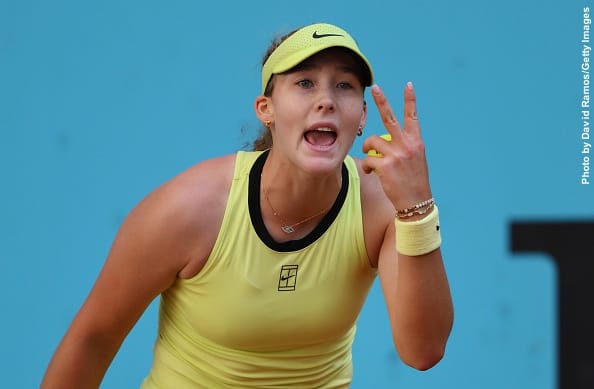
In Andreeva’s game, there is no sense that each shot exists in isolation. The serve, return, depth, cross-court shots, and positioning for a more favorable attack are all interconnected. It is precisely this cohesion that distinguishes a player who simply hits the ball well from a tennis player who knows how to control the match.
Several consistent signs of mature tennis are already evident in her game:
- early preparation for the shot allows her to meet the ball without panicking;
- her two-handed backhand helps her maintain her rhythm even under pressure;
- changes of direction don’t look like random gambles;
- a short losing streak doesn’t always ruin the entire set.
The last point is particularly important. In the women’s tour, many matches are decided not by a single impressive stretch, but by the ability to stay composed after a setback. Andreeva may still react emotionally to mistakes, but she is increasingly getting back into the match faster than is usually expected of young players
Russian tennis has found a different kind of leader
The Russian women’s tennis school is accustomed to strong personalities, a powerful backcourt, and players who reach the top early in their careers. But Andreeva adds a different dimension to this tradition. She doesn’t seem to be merely a continuation of the old model, where the main weapons are pace and aggression.
Her tennis is closer to a game of constantly reading the situation. She can vary her height, hold the diagonal, wait for a drop shot, and then accelerate sharply. There is a calm, chess-like quality to this that blends well with modern physical tennis.
For Russian tennis, this is also important symbolically. After generations of standout players, it’s always difficult not to compare new players with former champions. Andreeva is gradually moving away from these comparisons: her path is built not on imitation, but on her own blend of technique, patience, and early tour experience.
Major tournaments as a test of character
At major tournaments, the pressure is different from that of a typical week on the tour. There are more breaks, more attention, higher expectations, and matches that keep people talking about you longer than usual. For a young player, this is a unique challenge: you have to cope not only with your opponent, but also with your own status.
Andreeva already knows that a deep run in the tournament changes how people view you. Opponents don’t face her as a promising young player, but as a rival they need to figure out in advance. This amplifies the impact of every weakness: the serve, the second shot, emotional reactions, and movement after prolonged rallies.
But it is precisely these conditions that make growth visible. If a player can handle the attention, they stop relying on a one-time burst of inspiration. Major tournaments test not whether a person is capable of playing an outstanding match, but whether they can maintain a high level of play day after day.
What her story says about maturity in sports
Andreeva’s story clearly shows that maturity in sports isn’t the same as age. It comes down to the ability to make decisions, keep emotions in check, and not confuse boldness with recklessness. This is especially evident in tennis, because a player is alone on the court and can’t hide behind a team dynamic.
Her journey shouldn’t be turned into a finished legend just yet. Ahead lie slumps, tough opponents, grueling weeks on grass, exhausting flights, and matches where nothing goes according to plan. But it’s already clear: Russian tennis has gained a player who matures not through slogans, but through the quality of her decisions.
That is precisely why Andreeva is interesting to watch not only in moments of victory. Her main development takes place between rallies: in the brief pauses, in the choice of her next shot, in her ability to accept a mistake and play clearly again. For professional tennis, this is a far more significant sign than an early sensation.