
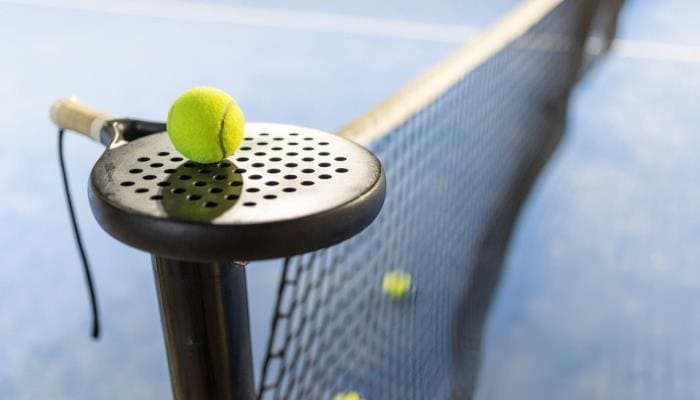
Padel tennis is a team sport played on a glass court where the walls are part of the game! It’s simpler than tennis and more dynamic than squash. History, rules, equipment, where to play in Russia.
#Padel #PadelTennis #SummerSports
Padel tennis (often abbreviated to “padel”) is a dynamic racket sport for four players (2 on 2). It combines elements of tennis, table tennis, squash, and badminton. The game is played on a court half the size of a tennis court (20×10 m), which is enclosed by glass and mesh walls. These walls are an active part of the game: the ball can bounce off them.
History: from a personal idea to a global trend
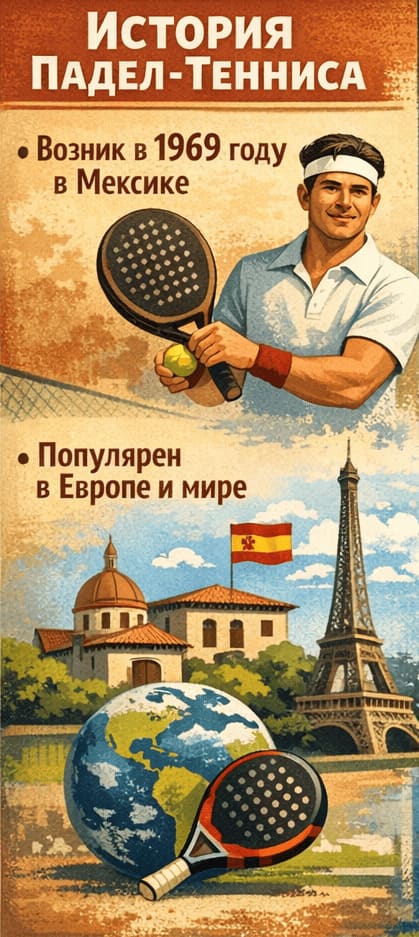
It all started not with royalty, but because of a simple lack of space. In 1969, Mexican millionaire Enrique Corcuera couldn’t fit a full-size tennis court on his property in Acapulco. The solution was ingeniously simple: he reduced the size of the court, surrounded it with walls, and came up with new rules. Modestly naming the game “padel Corcuera”, he had no idea that he had started a global trend.
Spanish aristocrat Alfonso de Hohenlohe, after visiting Corcuera, brought the idea to Europe. By the 1990s, padel had become a pastime of the Spanish elite, and Prime Minister José María Aznar (rumored to own a hundred rackets) made it a national treasure. Today, Spain is the capital of padel with 20,000 courts.
In 1991, the International Padel Federation (FIP) was created. In 1992, the first world championship used a court with glass walls, which improved the spectacle.
Today, more than 30 million people in 115 countries play padel. The leaders are Spain, Italy, and Argentina. Qatar is investing in the development of the sport through the Qatar Sports Investments fund, and the UK through the media holding company Daily Mail and General Trust (DMGT).
The sport saw a sharp surge in popularity during the COVID-19 pandemic, when people were looking for safe and accessible outdoor activities.
The main goal of the International Padel Federation is to have the sport included in the Olympic Games program. Work is actively underway to create national federations, and the discipline itself was presented at the 2023 European Games in Krakow. It is planned that, if a number of conditions are met, padel could make its debut at the 2032 Summer Olympics in Brisbane.
Interesting fact! Padel is loved by many celebrities and athletes. Among its fans are Lionel Messi, Cristiano Ronaldo, Nadal (who even has his own padel academy), David Beckham, and many others. They often post videos of themselves playing.
Padel in Russia
- Beginnings: Russian footballers playing in Spain (such as Valery Karpin and Alexander Mostovoy) were the first players.
- Development: The Russian Padel Federation was founded in 2017, and in 2019, padel was recognized as a separate sport. Today, there are about 40 clubs in the country, and tournaments and championships are held.
- Plans: The federation intends to make padel a mass sport by opening branches in the regions and training coaches.
Key rules and differences from tennis
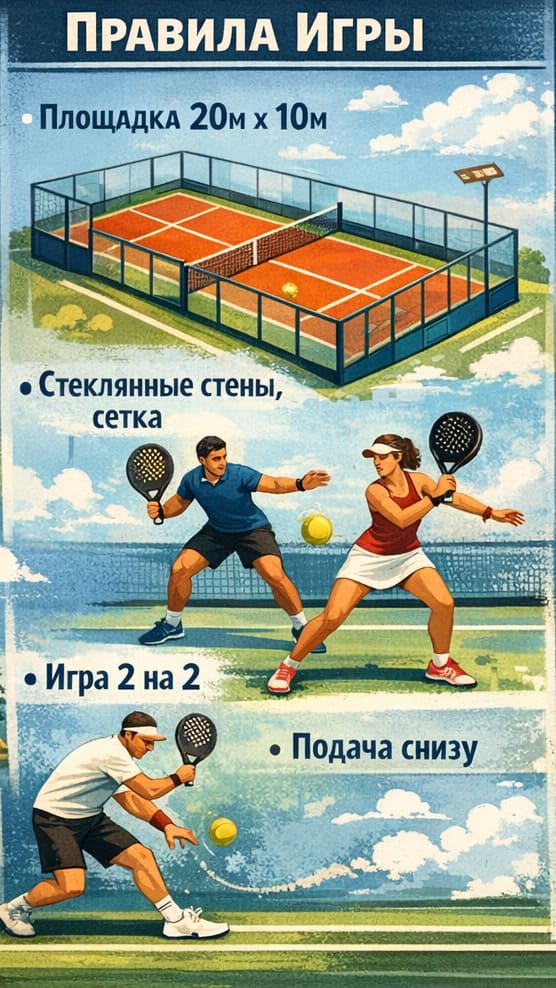
The scoring system is based on familiar tennis terms (15, 30, 40, game), but the rules are fundamentally different:
The padel court is half the size of a tennis court (20×10 m).
The net is lowest in the center (88 cm), while in tennis it is 91.4 cm.
Special serve: The serve is made from below, and the ball must bounce off the floor on the server’s side before being hit. Serving through the side glass is not only allowed but is also considered a good tactic.
Playing off the walls: Using the walls is the basis of the tactics. The ball can be directed at the wall on the opponents’ side, but it is forbidden to hit it directly into the wall (from the air) — it must first bounce off the floor.
Other nuances: It is forbidden to touch the net or walls during play, as well as to step onto the opponent’s half.
Interesting fact! In Scandinavia and Canada, heated outdoor panoramic padel tennis courts are being built, allowing people to play even in winter when temperatures are below freezing.
Inventory and equipment
- Racket: Short, made of composite materials. Round or teardrop-shaped models are suitable for beginners (more control). Price: 12,000 to 55,000 rubles.
- Balls: Special balls with a green stripe (e.g., Padel Pro). A pack of 3 balls costs between 600 and 1,500 rubles. It is acceptable to use the same balls as in tennis, but with one small trick: deflate them slightly before playing.
- Footwear: Specialized sneakers with reinforced lateral support and wear-resistant soles are required, as the court surface is granite chips. Price from 8,000 to 16,000 rubles. Professional padel players most often play in special squash shoes.
- Full set: A starter kit (racket, balls, shoes, uniform, bag) costs approximately 30,000 to 60,000 rubles. Many clubs offer equipment for rent.
Padel dictionary
As with any sport, padel has developed its own unique vocabulary, mainly based on Spanish terms:
- Bandeja (“tray”): an overhead shot with spin, aimed deep into the court.
- Víbora (“viper”): a more powerful and aggressive diagonal version of the bandeja.
- Chiquita: a short looping shot, similar to a drop shot in tennis.
- Salida (“exit”): a situation where a player runs outside the court to save a ball that has bounced off the wall.
Interesting fact! In Latin America and Spain, they joke about padel: “It’s like chips—you can’t stop at just one game.” Addiction sets in quickly because you get a rush from playing even with zero training. And then you buy your own racket, special shoes, and think only about when you’ll be back on the court.
Where to play and how much it costs
There are already more than 200 courts in Russia (Moscow, St. Petersburg, Kazan, Sochi, etc.). You can play in specialized padel clubs, premium fitness centers, or on outdoor summer courts.
- Court rental: On average, 1,500–3,000 rubles/hour on weekdays (cheaper for a group of four people). Prices are higher on weekends and in the evenings.
- Trial lesson with a coach: A great way to get started. Costs about 1,000–2,500 rubles/hour.
How to play padel tennis
Conclusion
Padel tennis is not just a trendy hobby, but a full-fledged sports revolution. Combining the dynamics of tennis, the tactics of squash, and the accessibility of team play, it is rapidly conquering the world. Its success is based on its ease of learning, social format, and economic efficiency, which makes it attractive to both stars and amateurs.
In Russia, the coming years will be decisive for transforming the local boom into a sustainable sports culture. If the current pace of infrastructure development and popularization can be maintained, padel could truly become one of the most popular sports in the country, offering a new, modern, and unifying sports identity.