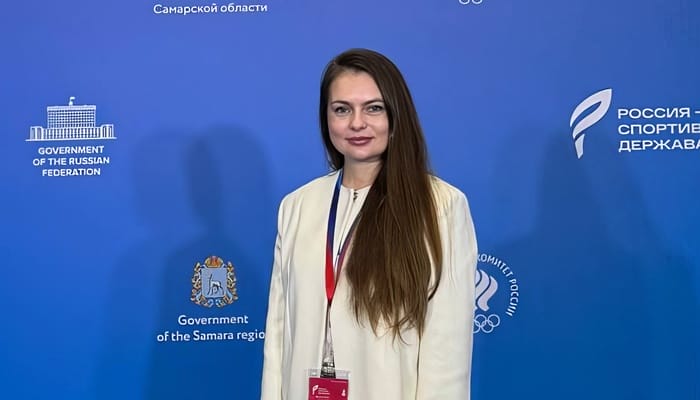
An athlete who became a national team psychologist. Oksana Yankovskaya on her path in sports, balance, childhood in elite sports, and preparing to work with the Russian national swimming team.
She started doing sports walking at the age of 15, and today she is preparing to psychologically accompany the Russian national swimming team. Especially for us, sports psychologist Oksana Yankovskaya spoke without embellishment about how children’s sports should not deprive childhood, what to do with the winter blues and why managing emotions is the same skill as hitting a shot.
– Oksana, please tell us how you first got into sports? And what is the best age to start?

My introduction to sports began quite early. From the first grade until about 14, I did ballroom dancing. The training was regular — five times a week, with a strict schedule and high discipline. And importantly: I don’t remember sport being a significant physical or psychological burden during that period. It was perceived as a natural part of life, not as pressure or an obligation.
I got into track and field at 15 — completely by chance and, by sports standards, quite late. Nevertheless, despite the late start, I managed to achieve decent results. And, honestly, if I hadn’t chosen family life back then, this path might have been even higher and longer. This experience perfectly illustrates that a “late start” is not a sentence.
As for the best age to start sports, there’s no universal answer. There are early-specialization sports — rhythmic and artistic gymnastics, figure skating — where an early start indeed provides more chances for top-level achievements. But it’s important to remember: an early start is not just a physical load but also a serious load on a child’s psyche.
And this is where balance plays a key role. Not just “starting early,” but creating conditions where a child develops without overload, maintaining interest, intrinsic motivation, and psychological health. Because in sports, it’s not only medals that matter, but also the person an athlete becomes at the end of this journey.
– Many believe that professional sports rob children of their childhood. Did you have a childhood?
To some extent, this is true, but it’s important to clarify: everything is very individual. In my practice, I often encounter children who, by ages 11–12, have completely lost the desire to train, experience strong fatigue, and even a physical and psychological aversion to the sport they’ve been doing since an early age. Typically, this is a result of overload, excessive expectations, and a lack of balance.
But that wasn’t my case. I had a real, lively childhood. Sports were a part of it, but they didn’t deprive me of joy, interest, or a sense of freedom. Training provided structure, development, and enjoyment, not a feeling of constant pressure.
Another crucial point to consider: in childhood, the choice of sport and training intensity is largely the parents’ decision. And it is their responsibility to shape this path for the child — making it developmental and supportive, or overloading and traumatizing.
Professional sports themselves don’t take away childhood. What takes it away is ignoring the child’s age, psycho-emotional state, and denying them the right to pause, rest, and choice. With attention, balance, and respect for the individual, childhood can be full even in elite sports.
– What do you remember most vividly from competitions during your youth period?
Perhaps one of the brightest memories is a trip with our group to a tournament in Yevpatoria, followed immediately by a training camp. Our pair performed very well then; we took two second places, and, of course, that was important and pleasant. But even now, it’s hard to say what left a stronger impression — the results themselves or the atmosphere of the training camp.
Early wake-ups at 6 a.m., morning runs that were excruciatingly hard for me back then. If someone had told me at that moment that my life would be connected to track and field, running, race walking, hundreds of kilometers of training — and that I wouldn’t just cope with it but genuinely love the process and enjoy it — I would never have believed it.
From athletics, I very clearly remember my first competition. I don’t remember the result or placement, but I perfectly remember the feeling: I really suffered back then. Those were my first official 3 kilometers of race walking.
It definitely wasn’t fast or about a high result, but it was precisely at that moment that I decided very clearly for myself: I want to catch up with everyone, and then — overtake them in Moscow.
I’m a very goal-oriented person by nature, and that’s exactly what happened in the end. My last start at the Moscow Championship ended with a confident victory. For me, this is a very clear example of how a first difficult experience, even without medals or fast times, can become a point of genuine internal motivation and growth.
– What guided you in choosing a career as a sports psychologist?
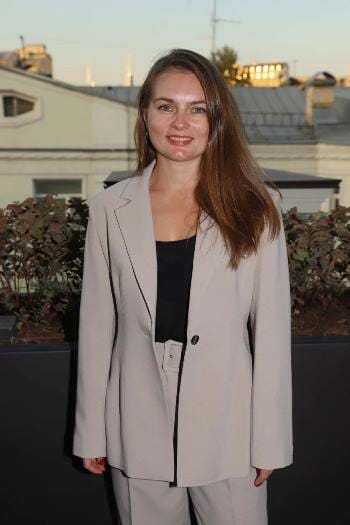
Largely, my own experience. There was a period in my athletic career when I worked with a sports psychologist, and the result I got was truly transformative for me. It was then that I understood how profoundly psychology affects an athlete’s performance, resilience, and state. That became the point from which I consciously pursued a second higher education in psychology.
I really wanted to popularize sports psychology. I clearly remember how, during my sports years, many of my friends faced precisely psychological difficulties — anxiety, fear of mistakes, loss of confidence, burnout — but simply didn’t understand where to go or who to turn to. Plus, there were (and still are) many myths: that “strong athletes don’t need a psychologist,” and “a psychologist won’t help weak ones anyway.” These attitudes often prevented athletes from getting timely support.
Today, thankfully, the situation is changing. In the age of social media, athletes have much greater access to information and specialists. I and many of my colleagues run professional blogs where you can not only learn about a specialist’s approach, methods, and values, understand if they are a comfortable fit for you as a person, but also get real tools for psychological self-help. And for me, it’s especially valuable to be part of this process and help athletes build not only results but also internal support.
– How is a sports psychologist different from a classical psychologist? What tasks does a sports psychologist have?
Sports psychologists and classical psychologists work with different tasks and in different contexts. Classical psychology is most often aimed at self-understanding, working with internal conflicts, relationships, past experiences, emotional trauma. The process of awareness and personal change is important there.
A sports psychologist operates within the logic of results and efficiency. We deal with a person under high loads: physical, emotional, social. It’s constant evaluation, comparison, competition, expectations from coaches, parents, fans, federations — and at the same time, the need to show stable results here and now.
The key task of a sports psychologist is to make the athlete’s psyche a working tool. Not perfect and “without emotions,” but resilient and manageable. We don’t remove fear, excitement, or tension — we teach the athlete to understand their state and act effectively even when feeling anxious, struggling, or unstable inside.
In practical terms, a sports psychologist works with:
- competitive stress and pre-race anxiety;
- fear of mistakes and fear of defeat;
- loss of confidence and inconsistent performances;
- emotional breakdowns during competitions;
- recovery after injuries and unsuccessful starts;
- burnout and loss of motivation;
- communication with coaches, teammates, parents;
- transitions: from juniors to adult sports, from sports to life after a career.
Another important aspect is the format of work. A sports psychologist is integrated into the training and competitive process. This isn’t just office conversations, but also work at training camps, competitions, within the team, in specific game and competitive situations. Often, it’s very applied, quick, and precise work—when a solution is needed not “sometime,” but within the next few minutes or days.
And perhaps the main difference. In sports, the winner isn’t the one who doesn’t experience emotions, but the one who knows how to manage them.
Therefore, sports psychology is the systematic training of mental resilience, concentration, and confidence, just as strength, endurance, and technique are trained. In this sense, a sports psychologist is part of the performance preparation team, not just a specialist “about feelings.”
– Is there seasonality in the work of a sports psychologist? What problems are more common in the winter period?
In the classical sense, there are no “seasonal” psychological problems in sports. An athlete’s psychological states depend not on the time of year itself, but on the specifics of the sport, the competition calendar, and stages of preparation. Each sport has its own seasons of starts, its own cycles of load and recovery — and these shape the main psychological demands.
For example, in some sports, winter is the peak of competitive activity, high levels of responsibility, and pressure for results. In others, it’s a period of extensive foundational preparation, monotonous work, and accumulated fatigue. There are sports where winter is for recovery and reassessing the season, and those where the foundation for future victories is laid precisely during this period. So, it’s incorrect to talk about “winter problems” that are the same for all athletes.
Nevertheless, certain states can indeed intensify in winter: decreased energy due to lack of light, a feeling of a drawn-out process, fatigue from large training volumes, or conversely, anxiety before important starts. But this is not about the season; it’s about the combination of external factors with a specific preparation stage in a given sport.
The task of a sports psychologist is to consider the specifics of the discipline, the calendar, and the athlete’s individual reaction to loads. We work not with winter or summer, but with where the athlete currently is in their preparation cycle and what internal resources they need to pass through this stage resiliently and effectively.
– Please give practical advice on how to maintain a positive mood in winter.
Winter is a period when energy levels naturally decrease, and it’s important not to demand constant high spirits and “eternal motivation” from yourself. My main advice is to shift the focus from expecting certain emotions to caring for your state.
First, maintain rhythm and structure. A clear sleep schedule, movement, and meal times give the nervous system a sense of stability — a foundation for a positive mood. Even a short daytime walk or light workout is better than complete inactivity.
Second, add small sources of pleasure to your daily routine: warm lighting, cozy rituals, favorite tea, music that uplifts you. These simple things truly work on a psychophysiological level and help reduce internal tension.
And third — allow yourself to not be in a perfect mood. Paradoxically, it is the acceptance of your state, without self-criticism and pressure of “I should be cheerful,” that most often restores resources. Positivity isn’t constant joy; it’s the ability to support yourself carefully in any season.
– In the near future, you’re taking on a new position. What is it? How are you preparing for it?
For me, this is an absolutely logical and conscious continuation of my professional activity. Starting in January, I am assuming the position of sports psychologist for the Russian national swimming team. This sport has long been and deeply present in my practice: since 2019, I’ve been working with top representatives of swimming, and, as I sometimes say with a smile, a truly large number of national team athletes in this sport have come through my work.
I really love swimming and the specifics of working with swimmers — their discipline, endurance, the fine psychological tuning between races. This is undoubtedly an interesting and at the same time very responsible task, especially now, when our swimmers are confidently and powerfully returning to the world stage. At the moment, key priorities are selection and preparation for international starts, including the Olympic Games, where every athlete and the team as a whole aim to perform with dignity and show that the level of swimming in our country remains at the highest level.
I can’t say I’m preparing for this role in some special way — rather, I’m systematically continuing to do what I know and do well. Of course, I’m thinking through the work structure, main focuses, and potential demands at different stages of preparation in advance. But at the initial stage, it’s fundamentally important for me to get acquainted not only with all team members but also with the coaching staff. I sincerely believe that we are a single team, tuned to one big result.
It is precisely well-structured interaction between athletes, coaches, and the sports psychologist that creates that resilient system which allows the team to achieve a high level of performance. It’s important to me that the athletes feel comfortable working with their psychologist, that they see me as a support — a person they can come to at any moment during preparation: for support, a conversation, analysis of their state, or a specific situation.
– How do you plan to combine your new position with your established routine? How does your family feel about seeing you less often?
The new position will undoubtedly make adjustments to my usual way of life. And, of course, the first question that concerned me not as a specialist, but as a person and a mother, was how the children would react. I’m a mother of many, and it’s important for me not only to grow professionally but also to keep the family stable and feel my presence, even when I’m physically traveling.
We talked about this honestly with the children. It involves training camps, competitions, business trips, while the children have their own busy lives: school, clubs, lessons, schedules. Here, my parents have been a huge support for me. They immediately said this was an important and big step in my career and that they support me at such a moment.
Besides, the children are no longer little — they are 14, 10, and 9 years old. They understand a lot, can take on responsibility, and, what is especially valuable to me, they are sincerely proud of what I do. So, I see this as a matter of balance and agreements: sometimes I’ll be physically absent, but emotionally and genuinely involved in the children’s lives.
For me, this isn’t about “choosing between,” but about the ability to build a system where both professional fulfillment and family remain important and vibrant parts of my life.
Oksana Yankovskaya: Sports Psychologist | MSMC Athletics
As a sports psychologist and coach, he creates individual mental preparation strategies for professionals of all levels — from world sports stars to those who are starting or finishing their career.
Education: Moscow Institute of Psychoanalysis
Link: Telegram / Instagram