
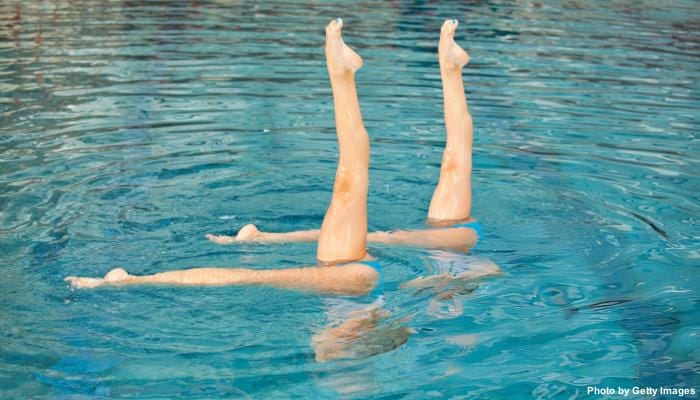
Synchronized swimming is a highly complex sport that combines swimming, acrobatics, and choreography. It is a sport in which Russia has dominated for decades.
#SynchronizedSwimming #ArtisticSwimming #TypesOfSports
What is synchronized swimming? It is not just a sport, but a harmonious fusion of several arts. Swimming, acrobatics, aerobics, and, of course, choreography form the basis for spectacular performances. Teams or duets perform complex figures and movements in the water to musical accompaniment, which from the outside look like an easy and graceful dance.
The secret of this apparent weightlessness lies in tremendous hard work. Each performance is the result of many hours of daily training, honing not only technique but also the coordination of all participants’ movements to achieve complete unity. For spectators, it is a water show; for athletes, it is a discipline that requires the highest level of skill, endurance, and artistry.
Historical path
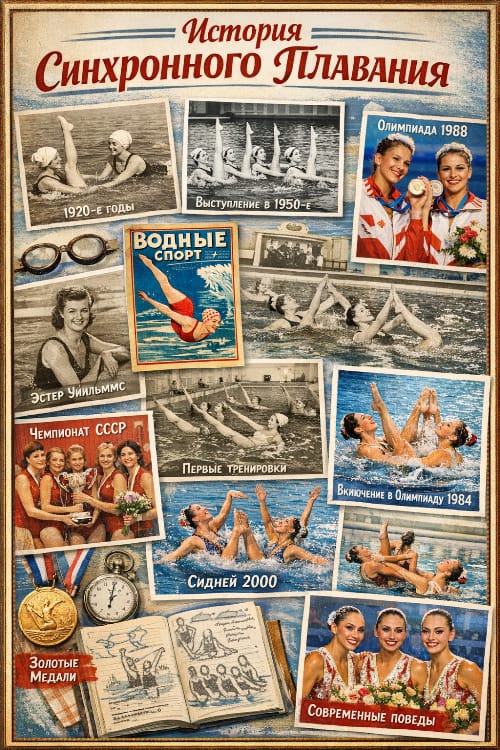
Synchronized swimming has its roots in ancient times. Even in Ancient Greece, there were entertainments reminiscent of modern performances—a kind of round dance on water. A form closer to sport appeared at the end of the 19th century in England, where groups of swimmers (mainly men) performed various figures on the water. In 1891, Berlin even hosted the first official “figure swimming” competition, also among men.
The modern history of the sport began in 1945 with the first competitions for women. The Olympic debut took place in 1948 in London, where synchronized swimming was presented as an exhibition sport. It took another 20 years for the discipline to gain Olympic status: the first medals were awarded only at the 1984 Games in Los Angeles.
The development of synchronized swimming in Russia began long before it gained international recognition. The discipline began to develop in the 1920s as “artistic swimming” in the form of performances at water festivals and in the circus. Systematic development took place in the 1960s and 1970s with the first city and all-Union competitions.
After synchronized swimming was recognized as an Olympic sport in 1980, Soviet athletes made their debut at international competitions in 1981. However, their triumphant march to the top began with the Russian stage. Starting with the Sydney Olympics, the Russian team has not lost a single Olympic gold medal to its rivals.
We owe these successes to outstanding coaches and athletes. Head coach Tatyana Pokrovskaya, who came from artistic gymnastics and created the strongest team in the world, played a special role. Five-time Olympic champions Anastasia Davydova, Svetlana Romashina, and Natalia Ishchenko became legends.
In 2017, men officially returned to the discipline, gaining the right to compete in singles and pairs competitions. In addition, in 2017, FINA (the International Swimming Federation) officially renamed the sport artistic swimming to emphasize the importance of the artistic component, choreography, and interpretation of music, rather than just synchronization.
Contemporary performance rules and programs
Today, at major tournaments, including the Olympic Games, two sets of awards are presented: for performances by duets and teams (groups). The rules for these formats have their own characteristics.
Each competition consists of two programs:
- Technical (compulsory) program. Includes a strictly defined set of figures that are regulated by the rules for a specific season. The combination of figures is determined by a draw 18-36 hours before the start, so athletes must have a perfect command of the entire arsenal of elements. A duo has no more than 20 seconds to perform the technical program, and a team has 50 seconds.
- Free program. This gives more scope for creativity. The team and coach independently select the music, theme, and choreography, striving to create a unique and complex composition. This is where the artistic talent and individuality of the team are fully revealed.
The judging system is similar to figure skating. Performances are evaluated by two groups of judges (5 people in each) on a ten-point scale, giving separate scores for technique and artistic merit.
Interesting fact! A three-meter depth in synchronized swimming pools is a mandatory safety requirement. This depth (no less) is necessary for performing the highest lifts and throws, when the athlete is lifted above the water on outstretched arms.
Technical secrets and complex figures
Behind the external beauty lies a well-thought-out technical base.
- Equipment and gear: To protect against water ingress during prolonged upside-down positions, athletes use nose clips. They hear music underwater through special underwater speakers, which allows them to stay perfectly in sync. To maintain a flawless appearance, special waterproof makeup and a special gelatin-like hair styling product are used.
- Figures and elements: Each figure has its own name and requires refined technique. Synchronized swimmers must be proficient in various swimming styles (front crawl, breaststroke, butterfly) adapted to the tasks of the performance. Among the key elements are:
- “Angle”: the athlete’s body is in a vertical position, with one leg raised perpendicular to the surface of the water.
- “Dolphin”: circular rotation of the body in a vertical plane.
- “Barracuda”: one of the most spectacular and difficult figures, in which the athlete stands vertically in the water, but upside down, keeping her feet on the surface. Performing such elements requires incredible strength, breath control, and team coordination.
Interesting fact! Female athletes do not use earplugs. They need to feel the water in their ears in order to determine their position in the pool and depth of immersion based on changes in pressure, especially when performing elements upside down with their eyes closed.
Training, preparation, and benefits
The path to the top begins in childhood. As three-time Olympic champion Olga Brusnikina notes, synchronized swimming is a universal sport for harmonious development. In addition to swimming training, young athletes are actively engaged in:
- General and special physical training.
- Choreography and plastic arts.
- Stretching to develop flexibility.
This comprehensive approach not only prepares future champions, but also brings significant health benefits: it forms beautiful posture, promotes the harmonious development of all muscle groups, and cultivates a sense of rhythm, artistry, and team spirit.
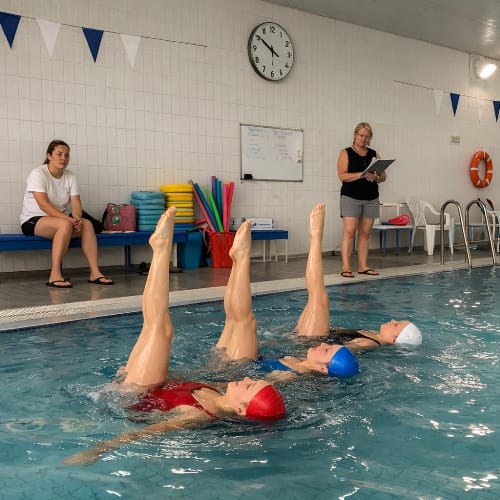
The most important thing for starting classes is not so much the ability to swim (although it is welcome) as a sincere desire to immerse yourself in this amazing world where sport becomes art.
The ideal age to start synchronized swimming is 5-6 years old, but many clubs offer preparatory groups for 4-5 year olds, where children are taught to feel the water, develop musicality, and instill a love of swimming through play.
Serious training with elements of synchronized swimming begins at 6-7 years old, when children are ready for more structured classes, teamwork, and learning their first simple figures.
A later start (at 8-9 years old) is also possible, especially if the child is physically well-developed and a quick learner.
Interesting fact! In synchronized swimming, the swimsuit is a high-tech piece of equipment and part of the scoring. Its design, approved months before the start, visualizes the theme of the performance. One costume can weigh up to 1.5 kg due to thousands of rhinestones and embroidery applied with special glue and threads that are resistant to the aggressive environment of the pool. The loss of even one decorative element threatens penalty points, so control over the fastening is total.
The culmination of the preparation is the “sewing” process. Using special surgical or waxed threads, the costume is sewn by hand to the training leotard so tightly that there is no gap between the fabric and the skin. This eliminates any displacement and “sail” that could disrupt the clean lines in the water. After the performance, the suit usually has to be cut open — this is the price to pay for absolute fixation and a flawless image.
Synchronized swimming
Conclusion
Synchronized swimming is a unique symbiosis of high athletic skill and graceful artistic creativity. From ancient water dances to modern Olympic competitions, this sport has come a long way, becoming a complex and spectacular discipline. Behind the apparent ease and grace lie years of hard training, flawless teamwork, and mastery of a multitude of skills, from acrobatics to choreography.
Equipped with underwater speakers, special gear, and makeup, athletes can create truly fantastic scenes on the water. This sport not only trains champions but also promotes harmonious physical and aesthetic development, making it an excellent choice for the younger generation.