

All about rugby: history, rules, game variants, and scoring. What’s the difference between Rugby-7 and Rugby-15? The specifics of beach rugby and the development of this sport in Russia.
#Rugby #TypesOfSports
Rugby is a fusion of strategy, raw power, and incredible dynamism, where elements of football, basketball, and wrestling are woven into a unique sport. Let’s delve into its essence, history, and game variants.
History and spirit of the game
This dynamic team ball game with an oval-shaped ball originated in England. According to legend, in 1823, a schoolboy named William Webb Ellis, during a football match in the town of Rugby, broke the rules by picking up the ball and running with it towards the goal area. This moment marked the birth of a new sport. The final separation of football and rugby occurred several decades later when a key rule was established: in rugby, the ball can be carried in the hands.
Key milestones:
-
1845: First written rules at Rugby School.
-
1886: The International Rugby Board (World Rugby) was founded.
-
1895: The Great Split, leading to two codes: rugby union (amateur) and rugby league (professional).
-
1900: The beginning of rugby’s Olympic history, but it was short-lived—tournaments were held at only four Games (1900, 1908, 1920, 1924).
-
1995: Revolution. The International Rugby Board allowed professionalism. This exploded the game’s popularity, leading to the creation of grand tournaments and commercial success.
-
2016: A triumphant return to the Olympic Games, but in the Rugby-7 format.
Rugby in Russia

– Origins (1892): The first matches were held in the Russian Empire, 30 years earlier than the commonly accepted date.
– USSR: After the 1917 revolution, the game developed with the support of Lunacharsky, but in 1949 it was unexpectedly banned. It was revived through the efforts of students in 1959. The USSR national team performed successfully in Europe.
– Modern Russia: After 1991, Krasnoyarsk clubs have dominated. The men’s national team participated in two World Cups. The women’s national team in Rugby-7 has achieved notable success. Beach and snow rugby are developing.
The essence of the game
Rugby is a team game where the objective is to score more points than the opponent. The unusual ball, resembling a melon in shape, weighs about 500 grams and is up to 30 cm long. Its surface is often coated with a special compound that repels mud.
The field for classic rugby (Rugby-15) includes:
-
A main part up to 100 m long and 70 m wide.
-
Two try zones (in-goal areas) up to 22 m deep each.
-
H-shaped goal posts 5.6 m wide with a crossbar 3 m high.
A distinctive feature of rugby is the variety of ways to earn points:
-
Try (carrying the ball into the opponent’s in-goal area) — 5 points.
-
Conversion (a kick after a try) — 2 points.
-
Penalty kick — 3 points.
-
Drop goal (a kick from a drop during open play) — 3 points.
The fundamental rule is that the ball cannot be passed forward with the hands. It can only be passed to a teammate who is level or behind. Forward passes, knock-ons (dropping the ball forward), or the ball going into touch (out of bounds) result in a stoppage and a set piece (scrum or lineout).
Interesting fact! Why is the ball oval? Originally, rugby balls were made from a pig’s bladder, which, when inflated, took on an oblong, oval shape. Later, they were covered with leather. A ball of this shape is easier to grasp and carry in the hands, and its unpredictable bounce complicates the game.
Lineups and variants of rugby
In classic rugby, 15 players from each team take the field:
-
Forwards (numbers 1-8): The “heavy infantry” of the team. Their main tasks are the power struggle in scrums, tackles, creating a “bridgehead” for attack, and contesting possession.
-
Backs (numbers 9-15): The “brain” and “speed” of the team. This group includes the fullback, who is often the last line of defense. There is no goalkeeper in rugby, so field defense is the responsibility of the entire team, especially these players.
Over time, other popular formats have emerged:
| Format | Players | Characteristics | Halftime Duration |
|---|---|---|---|
| Rugby-15 | 15 | The classic, strategic variant with intense physical contest. | 2 × 40 min |
| Rugby-7 | 7 | An Olympic discipline. A very dynamic game on an open field where speed and technique are crucial. | 2 × 7 min |
| Rugby-5 | 5 | Beach or snow variant. No goalposts or scrums; points are scored only for tries. Very fast pace. | 2 × 5 min |
The emergence of different types is due to practical reasons: Rugby-7 was created to reduce club costs, while beach and snow formats adapted the game to the climate and leisure conditions.
Interesting fact! The Rugby World Cup is the third most-watched sporting event in the world after the Olympic Games and the FIFA World Cup. For example, the 2015 tournament in England contributed about 2.5 billion euros to the global economy.
Features and key elements of the game
-
Physical Contest: Tackling the player in possession of the ball is permitted.
-
Scrum: Awarded after minor infringements. Eight forwards from each team bind together to form a tunnel, and the ball is thrown in to contest possession.
-
Lineout: A method of restarting play after the ball goes into touch. Players line up in parallel lines, and the ball is thrown between them.
-
Player Requirements: Strength, endurance, agility, quick reaction time, and the ability to make instant decisions in a fast-changing environment are necessary.
How to start?
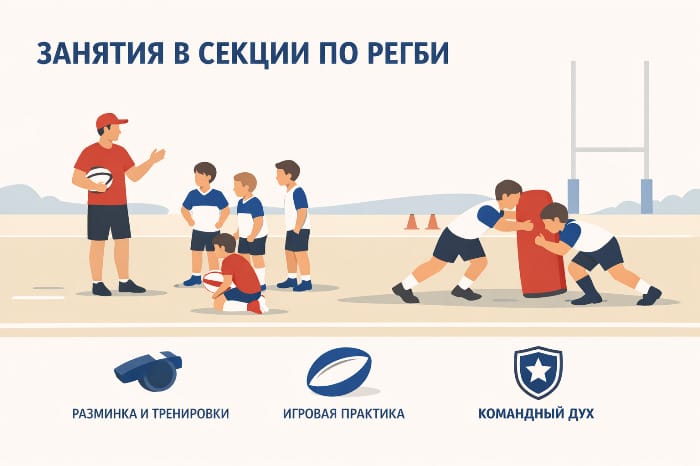
The best first step is to find an amateur club or section in your city. Introductory training sessions are often held for beginners. At the initial stage (3-5 years), expensive equipment is not required—just sportswear and desire. Basic skills—running, proper tackling, and passing—are learned relatively quickly under a coach’s guidance.
From ages 8-10, elements of touch rugby are gradually introduced, followed by soft contact. Full-contact tackling and scrums are introduced step by step, with a mandatory focus on proper technique, which minimizes injuries. This is a key stage for skill development.
Upon transitioning to junior categories (15-18 years), teenagers begin playing by “adult” rules. Here, not just age, but the player’s physical and psychological readiness comes to the fore. The development of strength, endurance, and tactical thinking becomes a priority. Many professional rugby players started their journey at this age.
For adults, there are amateur clubs and tournaments at various levels. It is especially important for adult beginners to spend time mastering tackling and passing techniques to play safely and enjoy the game.
Rugby rules
Conclusion
Rugby is not just a team sport but a true philosophy that combines physical power, strategic thinking, and an unyielding spirit. From its medieval roots to modern Olympic formats, the game has proven its uniqueness and ability to adapt, giving rise to dynamic varieties like Rugby-7 and beach rugby.
The development of rugby globally and in Russia, including the national team’s successes on the European stage, shows the growing popularity of this sport. It continues to attract new fans and athletes ready to test themselves in a game where both body and character matter.
Rugby teaches the main lesson: a true victory is not only the result on the scoreboard but also overcoming one’s own limits, trusting teammates, and respecting the spirit of rivalry. That is why everyone who associates their life with this game can rightfully take pride in the title of a rugby player.