
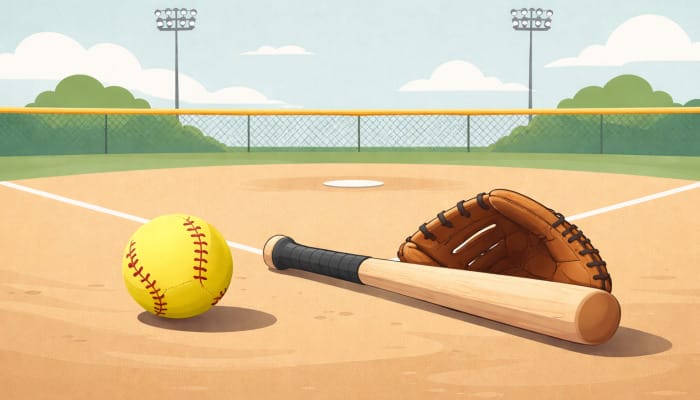
Softball: from a casual game in high school to an Olympic sport. What is the essence and philosophy behind it? Brief rules and the optimal age to start playing.
#Softball #TypesOfSports
When it comes to ball and bat sports, most people immediately think of baseball. However, it has a younger but no less exciting counterpart — softball. It is often mistakenly referred to as a “simplified version” or “baseball for women,” but it is an independent sport with a rich history, unique philosophy, and exciting dynamics. Let’s take a look at what makes softball special.
The history of softball
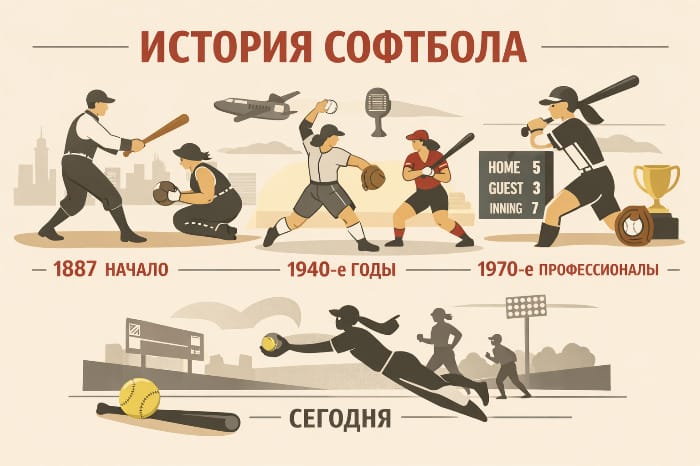
The history of softball is a classic example of a sport that was born by accident and became a global phenomenon. Unlike baseball, whose origins are shrouded in legend, softball has a precise date and place of birth: Thanksgiving Day, 1887, Chicago.
It all started at the Farragut Boat Club gymnasium. A group of Yale and Harvard University alumni were waiting for news about the outcome of the traditional football game between their alma maters. When the telegraph brought news of Yale’s victory, one of the fans, in a burst of emotion, threw a boxing glove at his rival. The latter waved it away with a stick. Journalist George Hancock, who witnessed the scene, exclaimed, “Let’s play!” He tied the glove into a ball, drew an improvised diamond on the floor, and suggested a new game to the guests.
The game quickly became known as “Indoor-Outdoor” because it could be played both indoors and outdoors. The rules were constantly changing and being refined. In 1895, firefighter Lewis Robertson took the game outdoors in Minneapolis, naming it “kitten ball.”
From the US, the game spread around the world, becoming particularly popular in Canada, Japan, Australia, and Latin America. The culmination of its development was the inclusion of softball in the Olympic Games (in the women’s category) in 1996 in Atlanta, confirming its status as a serious and spectacular sport of the highest achievement.
The official name “softball” was established in 1926 thanks to Walter Hakonson, secretary of the YMCA Athletic Association in Denver. In 1933, softball received a tremendous boost to its development when it was included in the program of the World’s Fair in Chicago. The tournament was a resounding success, leading to the creation of the Amateur Softball Association of America (ASA).
Interesting fact! The National Softball Hall of Fame (Oklahoma City, USA) has the very first ball made from a boxing glove that George Hancock and his friends played with in 1887.
Softball in Russia
Softball appeared in the USSR in 1986 thanks to a sports cooperation agreement with the US Olympic Committee: Soviet specialists helped develop field hockey in America, while Americans helped develop baseball and softball in the USSR.
After the collapse of the Union, the Russian Baseball, Softball, and Russian Lapta Federation was created in 1992, and the first open national championship was held at the same time. In April 2002, softball became independent: a separate Russian Softball Federation (RSF) was formed.

On February 19, 2025, the FSR and the Russian Baseball Federation held a joint conference, at which they decided to merge into a single Russian Baseball and Softball Federation (RBSF).
The Russian women’s national team has regularly participated in European championships since 1992. The team achieved its greatest success at the turn of the century, winning bronze in 1999 and 2007, as well as silver medals in 2003.
Even more impressive results were achieved by the junior and youth national teams. Russian girls have won medals at the European Junior Championships six times, and at the European Youth Championships, the Russian team has twice become champions (2012, 2014) and twice silver medalists (2008, 2016).
Interesting fact! Vyacheslav Smagin from Tuchkovo near Moscow, founder of the legendary Karusel team, is the only Russian inducted into the World Softball Hall of Fame, located in the United States. His contribution to the development of this sport in Russia and Europe was marked with a personalized plaque and ring.
The philosophy of the game
At first glance, it may seem that softball is just a lighter version of baseball for amateurs. However, this is a profound misconception. The philosophy of softball is based on three pillars: accessibility, dynamics, and team spirit.
The essence of the game is much closer to chess than it might seem. It is an endless psychological battle between the pitcher (the thrower) and the batter (the hitter). The pitcher does not just throw the ball, he tries to outsmart his opponent, forcing him to either miss or hit the ball in an awkward direction.
At the same time, softball is a celebration of fairness. Unlike many sports, where the talent of one athlete can decide the outcome of a match, here every player sooner or later finds themselves in the spotlight. You can be a star on offense, but on defense, your mistake can cost your team the win. This teaches responsibility and the ability to support your teammates. It is precisely this combination of intellectual struggle and physical endurance that attracts millions of people around the world to softball.
Brief rules of the game
Although softball and baseball are similar, the difference in rules is significant and changes the entire dynamics of the game.
- Field and ball: The field is smaller than a baseball field, and the distance between bases is 18.29 m (in baseball, it is 27.45 m). The ball itself is larger in circumference (30.5 cm) but slightly lighter, and contrary to its name, it is not soft at all.
- Pitching: The main difference. In softball, the pitcher throws the ball from below (with the lower arm), while in baseball, the pitcher throws from above. The ball must be released strictly at the hip.
- Game duration: In softball, the game lasts 7 innings (as in MLB), not 9. An inning is considered over when the defense manages to get three batters out.
- Base running: The runner is not allowed to leave the base until the ball touches the bat (the pitch must be delivered to the strike zone or a swing must be made). This eliminates “stealing” bases in the usual baseball sense in the early stages.
- Strike zone: It varies from the knees to the shoulders (or sternum) of the batter, which makes the pitching zone wider vertically.
There are two main types of softball: fastpitch — the Olympic sport, where pitchers throw the ball at speeds of 110-120 km/h, and slowpitch — an amateur version, where the ball flies in a high arc, making the game more accessible to beginners and emphasizing the power of the hit.
Interesting fact! Softball has been adapted for athletes with hearing impairments. In this version, light signals (flashes) are used instead of whistles so that players can understand when the play begins or when the game is stopped.
At what age can you start practicing?
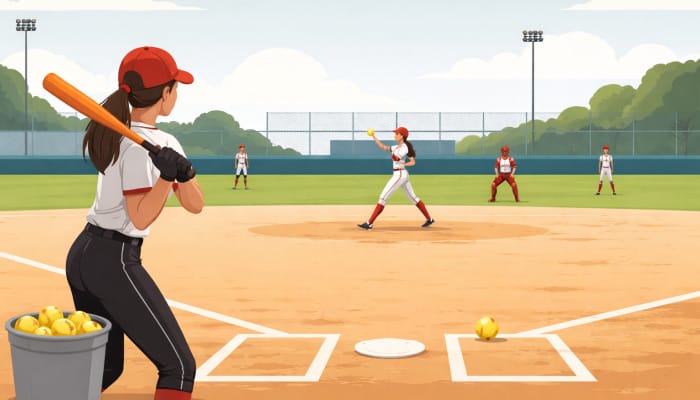
Softball is one of the most democratic sports in terms of age. You can start learning the game at a very early age.
5–8 years old (children): At this age, there are T-ball programs (a type of baseball/softball where the ball is placed on an adjustable stand). Here, children learn how to hit, catch, and throw the ball correctly, and get used to running between bases. At this stage, the game is played without a pitcher, which allows children to focus on coordination and eliminates their fear of flying balls.
9–12 years old (Teenagers): The optimal age to transition to classic softball with a live pitcher. At this age, the body is coordinated enough to master the correct underhand throwing technique, and the mind is ready for team tactical competition.
13+ years old and adults: Many people come to softball at a conscious age, especially to slowpitch. It’s a great way to stay in shape, participate in corporate leagues, and enjoy live communication. A professional career most often begins at 12-14 years old, but you can become an amateur at any age.
Softball. Only girls in the base
Conclusion
Softball is more than just a sport. It is a dynamic activity that combines elegant defensive plays, powerful offensive hits, and the tension of the pitcher-batter duel. It is a game that teaches you to analyze situations instantly and trust your teammates.
Unlike many other sports, softball combines high intensity with elements of rest and tactical pauses in a surprisingly harmonious way, making it exciting for both players and spectators. If you are looking for a sport that makes your heart beat faster and your brain work at its limit, while giving you the feeling of being part of a real team family, softball is the perfect choice.